Tag Archives: Hunger

Food Security and Ecology in India

ID-10042528

In India last year, there was an intense debate on the proposed Food Security Bill, centering mostly around the impact on the national budget and the mechanism of distributing extra supplies of food grains to consumers throughout the country. Parliament eventually passed the Bill but the question remains: is this really the food security initiative that will serve people best? For the rural population, which is primarily involved in agriculture, food security is not merely a matter of entitlement to a certain amount of cash or food grains; but is reflected in the existence of an available, accessible and assured source of food that will hold steady in the face of stresses and shocks to the food system. It is not just about hunger, it is about the ability to rely on a source of food in a stable way.

Traditionally, the food system for rural families comprises not only what they grow and the livestock they raise, but also what they extract from forests, streams and the surrounding landscape. The ecosystem can provide food directly (edible plants and animal and also medicinal plants), these can also be sold and the income used to purchase other food products; forests also provide firewood that is crucial for cooking (an adequate supply is required, for example, to cook proteins such as beans and meat which would help improve quality of diet). In terms of production, forests provide a habitat for pollinators, maintain/reduce soil erosion and fertility and mangroves and coastal forests reduce the impact of flooding to ensure stability in crop production and fish supply. Rural people, therefore, rely on the surrounding system for supplementing their diet as well as for their livestock and also to ensure that their crops can flourish. But this rural landscape and  the resources it offers also face degradation from overuse, pollution, deforestation all of which will be exacerbated by climate change. With the spread of urban living and tourism, rural populations without strong land rights are often shut out off lands to which they traditionally had access. It is in this context that a food security policy needs to be assessed. Can rural families count on an accessible, available and assured food supply?

On a broad scale, a balance has to be sought between conservation and production/consumption. Efforts at preserving and conserving the environment can sometimes lead to an artificial split in the landscape with certain areas marked for production and others for conservation. This negates the traditional integrated living patterns of rural people where forests and agricultural production coexist. By making an arbitrary divide in the environment, farmers are now excluded from access to resources that earlier supplemented their nutrition.

A recent World Bank report underlined that India would have to “value its natural resources, and ecosystems to better inform policy and decision-making.” This seems to be in accordance with what the Environmental Policy Report of 2006 which explained that “the dominant theme of this policy is that while conservation of environmental resources is necessary to secure livelihoods and well-being of all, the most secure basis for conservation is to ensure that people dependent on particular resources obtain better livelihoods from the fact of conservation, than from degradation of the resource.” How much of this translates into actual practice is another matter.

In terms of providing support to deal with stresses and shocks without further intensifying ecological degradation; the Food Security Act can be effective. If farmers could rely on this as a source of food, there would be less pressure to draw on an already threatened or depleted environment. This concern is brought into sharper focus as we face the challenge of climate change which would stress the ecosystem. All the effects of a policy that is blind to ecosystems will be further magnified by climate change. It has been estimated that there will a ten per cent extra increase in malnourished children world wide, as a result of climate change. India is particularly vulnerable, according to UNICEF, 1 in 3 malnourished children in the world live in India that makes future projections accounting for climate change of great concern. If food security policy assures them of at least a meal a day at school, that could have a big impact.

On the other hand, the Food Security Act is limited to a few crops and this has ecological implications as well. Due to the increased demand for these crops, farmers would find it profitable to opt for growing only a few major crops such as wheat or rice thus drawing more resources such as water to these two crops and reducing diversity in the production of food.

For an effective food security policy, ensuring access to ecosystem resources is crucial; it is not simply a matter of handing out grains/cash through a public system. An effective food security policy would view people and the ecosystem as integrated and design measures that work across sectors; so conservation/environmental policies would be devised in step with rural food security policy. It would recognize that food security also needs to be climate resilient and stresses brought on by climate change such as drought, and flood which impact access to food can be better managed by ensuring that production policies and conservation efforts are framed with the entire ecosystem in mind.

This post grew out of a Twitter discussion with @IndianBotanists and I thank them for their suggestion and appreciate their patience as this post came to fruition. (Image Courtesy:freedigitalphotos.net)

How Math Predicts Revolutions Based on Food Prices

revo

The point about rising food prices being a factor in social unrest has been explored before but now there is a model that can predict when and where revolutions will occur based on food prices. According to this, when the FAO food price index reaches 210, social unrest is triggered. Among the list of countries are some where this has happened on a large scale(Venezuela is a current example), some where it is still contained (India) and also some surprises (Sweden?!). The author of the study, Prof. Yaneer Bar-Yam of the New England Complex Systems Institute , points to two major causes for rising food prices: the rise of biofuels and speculation in commodities. And what happens to these two variables will determine if prices will be lower this year. Ethanol mandates are being debated in the US and EU, but speculation is another matter. It is spoken of much less than labeling, or any other food issue of the day.

Consider, also, the impact of climate change. (This was an important factor in the case of Syria, for instance.) Unpredictable weather events, a sudden drought or flood may result in a below average harvest; but higher prices in the global market (fueled by speculation) provide an incentive for exporting most of the crop. This would mean less is available for domestic consumption and  prices would rise for whatever is on the market. If prices were to rise to critical levels, as predicted by this model, social unrest would follow. 

What are the chances of regulating commodity speculation, proposing , for example, some limits for trading? It is difficult, perhaps, to be optimistic on this issue but it has to be highlighted in any conversation on the food system.  Food is a commodity, yes, but it is not like any other commodity. If trading in future, hypothetical, stocks of grain  means people are starving in the present then that is not an acceptable situation and efforts to correct it should not be blocked by purely financial interests.

(Image Courtesy: freedigitalphotos.net)

Feed a Child, Nourish a Mind: My Post for The Lunchbox Fund

Lunchbox Fund Photo 3

Everyday children go hungry all over the world. Not just in poor countries but even in places which seem to be rich in resources. These children might make the trip to school but are too weak to learn because their bodies and minds are  deprived of nourishment. Just when children are excited to hear about snow in the forecast bringing a day off from school, others cry because they will miss their only meal of the day.We think we feel their pain but nothing in our daily lives quite prepares us for the child who sits apart from others at lunch because watching other kids eat makes the pangs of hunger even harder to bear.

The Lunchbox fund is an initiative in South Africa to provide lunch in school to children who would otherwise go hungry. 65% of  children in South Africa live in poverty, 20% have been orphaned by AIDS; without parents and without food they are likely to slip out of school into a bleak future. This week, The Giving Table (http://www.givingtable.org/#home) has organized a campaign to support  The Lunchbox Fund and I am proud to donate this post toward this effort.

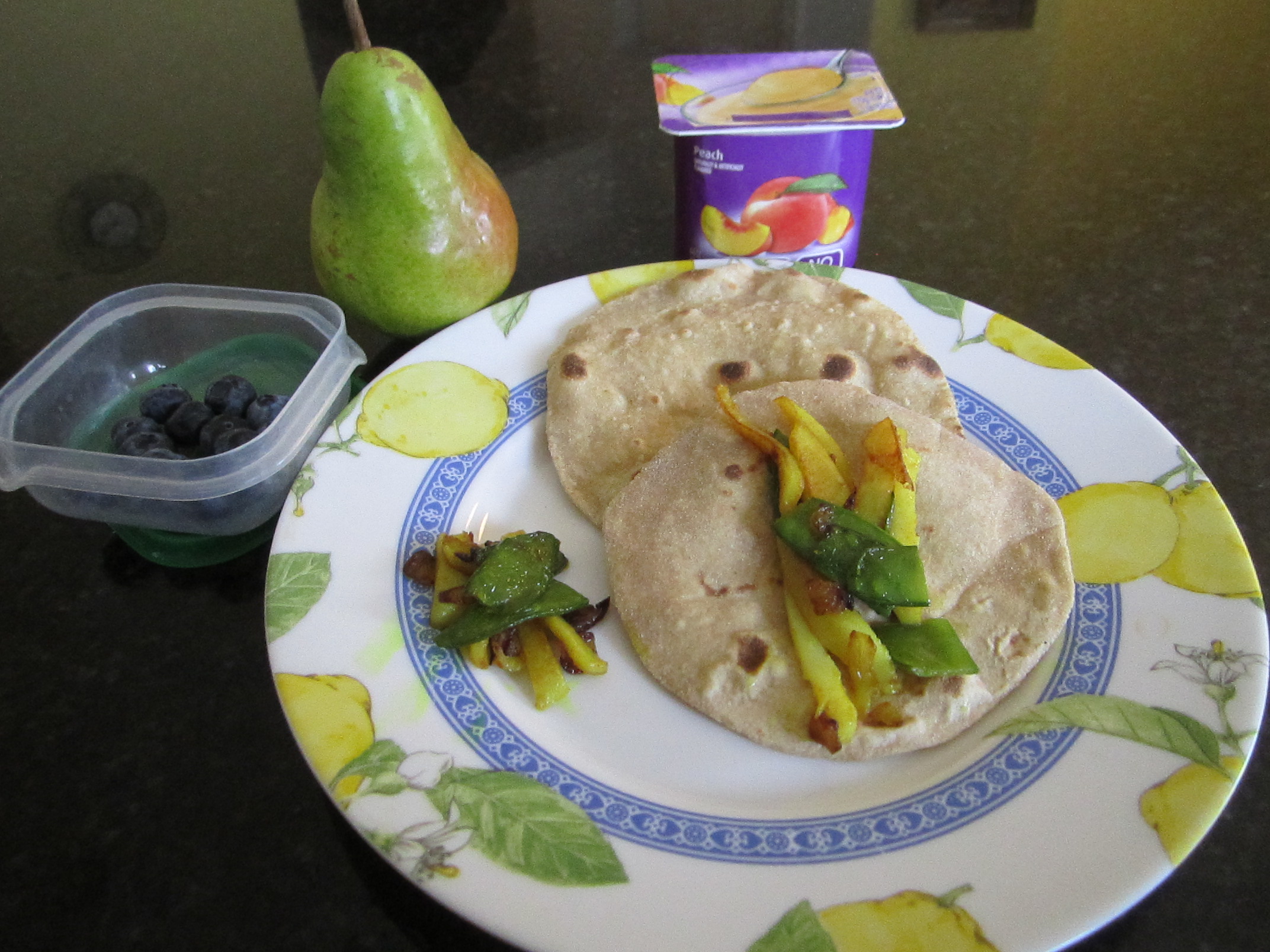
The theme for bloggers donating posts is lunch. In keeping with that, I thought I would share my story of packing lunch for my kids. When Kid 1 started school, we agreed that she would buy lunch on one day, usually on Friday when pizza was offered and the rest of the days I would pack lunch for her. Mindful of children with nut allergies, the school prohibits peanut butter but other than that we experimented and tried out every kind of sandwich filling we could imagine and my child was happy to eat sandwiches everyday. I would listen to the complaints of other parents about packing lunch for a picky eater and be thankful for my blessings. Then came Kid2 and my world turned upside down: the lunchbox would come back almost just as it was sent out, sandwiches were boring, pasta was “too cold”, chicken smelled “funny”, I just could not get it right.

Desperately searching for a solution, I fell back on the lunches of my childhood, the soft rotis , the delicious stuffing that my mother would roll up in them; and I decided to try and replicate it. Since Kid 2 is constantly vowing to become a vegetarian “from my next meal”, I have to chosen a simple and easy vegetable dish that makes the lunch nutritious and yummy.

IMG_0008

Easy Indian Vegetable Medley

Ingredients:

1 onion

1 potato

1 carrot

A few green beans/flat beans

2 or 3 stalks of cauliflower/broccoli

1 green chilli

1/2 tsp cumin seeds

1/2 tsp turmeric powder

Salt to taste

Method:

Slice the onion finely. The vegetables should be chopped fine, length wise. This ensures that all the ingredients are roughly the same size and will cook at the same rate so none are left too raw or overcooked. Any combination of vegetables will work but I have included our favorites, sometimes I have only two or three of these to hand but the recipe works just as well.

Heat oil in a pan. Keeping the heat at medium, add the cumin seeds (these are available at all Indian grocery stores and many regular grocery stores as well. if you do not have them, you can still go ahead and make this). When the seeds are toasted, they turn a darker shade and it is time to add the onions. Let them cook till they are soft and then add the vegetables. Toss all the ingredients together and let this cook for 2-3 minutes, stirring occasionally. Then add the turmeric (availability same as that of cumin) and salt ,and mix well. Cover and let it cook for about 5-7 minutes. Take off the lid and check to see if vegetables are tender but not mushy. At this stage  you can add the green chilli, sliced in half, for a little bite if you like. Increase the heat and cook for a minute so the vegetables are crisp and bright.

I usually roll this up in a roti  made at home with whole wheat flour. This can also be purchased at the Indian store or substituted with tortillas. Since the school day is long, this is supplemented with fruits and yogurt. Often, this is what I have for lunch as well.

IMG_0012

The campaign runs through this week and even donating my weekly coffee budget would make a difference,  and I certainly intend to do so.We have many choices for lunch, I intend to share this good fortune with those who have none and  make a donation here.Please do consider it as well.


How “Real” is the Hunger Games

cl2

The second movie in the Hunger Games series is out in theaters and is , as expected, doing extremely good business. The plot line of the series is fairly bleak but is it also a peek into a future that could happen to us. The story unfolds in a world ravaged by climate change and the conflicts that followed as people tried to grasp whatever resources they could. The heightened tension over sharing water, land grabs in countries far from home, the people killed or displaced by unstable weather that fill the headlines; all this is mere degrees away from the description of life in the Hunger Games books.

What is also striking is the contrast in living conditions in District 12 and the Capitol. It immediately calls to mind the classic descriptions of the colonial system taught in basic economics: resources extracted (often by coercion) from areas of the “periphery” to serve the needs of the rich and powerful “center”.  A more detailed analysis is here.

So ,while we eat more popcorn than is good for us and watch Katniss blaze on the big screen, it is a good time to reflect on the economic and historical paths we have walked and where we want to go in the future.


Just Label It!


cherry

I watched the GMO labeling debate closely in California and cheered when the proposition was defeated there. But when I read the arguments from the pro-labeling side,(based mostly on misinformation and unsubstantiated fears) I began to think that blocking labeling is perhaps not the best strategy. GMO foods, it has been proven, again and again, are  safe for human consumption. The pro-label lobby has therefore, framed the debate in terms of the “consumer’s right to know what is in their food”. It is hard to make the case that the consumer should not know/does not need to know what is in their food and so, blocking labeling makes it seem like the producers of food containing GM ingredients are hiding something. One would like to ask the question: how would knowing this be useful to the consumer anyway? If they do not want to purchase GMO products, there is already a label for them: it says “organic” or that fascinating mystery term, “natural” which many seem to rely on.

It is important to remember that this debate is being played out in parts of the world that have the luxury to debate about food. In other areas, where people are going hungry every day, children are malnourished and suffering from dietary deficiencies, food on the table is a survival issue. Biotechnology offers a way to combat global hunger. By  blocking labeling and letting the “there is something to hide” misinformation gain ground, we are denying choices precisely to those who are most vulnerable. If we continue to block labeling, the ultimate aim of the anti-GM lobby; to take biotechnology out of the options forever, would be achieved and this would be a disaster in the struggle to deal with hunger and malnutrition.

Instead, imagine a situation where the labeling issue is actively owned by those seeking to make sure the benefits of GM foods actually reach the public. Companies need to proactively steer the labeling issue in a positive direction: uniform labels for the whole country so that the same chaotic battles do not have to be fought over and over again in each state, providing more opportunities for spreading misinformation. The actual words on the label are crucial and that should not be dictated by the naysayers. Ideally, I would propose :”This product contains GM ingredients which have been more rigorously tested than most products in your grocery store. They are produced using less pesticides and so are better for the farmers who grow them and our planet. They are also fortified with Vitamin A (for example) which will prevent blindness and death in millions of children.” But that is a dream and in the real world, companies will have to work hard to merely ensure that negativity is minimized.

In purely economic terms, there is a far bigger market out there as measured by currently undernourished/malnourished people than the few who might switch from buying products post labeling. And, most important to remember, the one piece of information on the label which seals the deal for a consumer on a budget is the price.If there is an initial cost increase involved, companies need to refrain from passing that on immediately to the consumer. Instead, let them read the label, see the price, compare it to the high priced organic option and make their decision.

You can read more on both sides of this here and here.

GMOs: The View From Italy

italy

Absorbed as we tend to be in our own food system battles: food safety, labeling, etc; we tend to forget that similar struggles are taking place elsewhere. I always tend to think of Europe as solidly anti-GM although, there is a lively debate on right now in the UK, for example, on the adoption of GM technology. So, this piece on the import of GM corn by Italy was illuminating. First, the elaborate dance around growing/importing GM corn even when the current corn crop has been devastated by pests is entertaining to read. Also, I learnt that several countries in the EU do grow or import GM crops, somehow working through loopholes in the regulations banning this technology. And, finally, a familiar picture: no one is listening to what the farmers have to say. The final scene in the drama played out thus: Italian pigs will be fed GM corn imported from the US (but what will this mean for future prosciutto?!), while Italian farmers are left to deal with the consequences of a failed harvest. Too bad they cannot blame it all on Monsanto!

Drought, Hunger and Syria


syria

Looking at the news these days, it seems that the world is just coming apart and understanding all of this is impossible. But it is also difficult to turn away from, so I started reading this piece to learn about the situation in Syria. And when I came to point 6, I had to stop and read it again. How did I not know this already?

There was a severe drought in Syria from 2006 to 2011 which disrupted the rural economy. Lack of water meant that farmers lost their livelihoods and migrated to the cities to get whatever jobs they could, to keep their families from starving. The Syrian government, meanwhile, decided to sell off the grain reserves.  Already unsuccessful in dealing with the drought crisis, it now had no food to offer its citizens and had to import food. This, obviously, was not a viable solution and it is easy to see why violence, fed by this and other factors, has broken out.

Two things come to mind here: the issue of climate change and the breakdown of Syria’s food production system has largely remained invisible in the discussions on military action. How could a calamity that resulted in an estimated 2 to 3 million people being reduced to “extreme poverty”, have remained unnoticed?  And, for the future: as the impact of climate change on our food system becomes more intense;  this situation ,with minor changes in variables, could be repeated across the globe. What will we do then?

It is time to put the food system at the center of any debate on the future. If we talk of dealing with climate change, let us start by recognizing its crucial impact on how we grow food, if we want a more equal world, let us ensure that its roots lie in a just and fair food system, and if we want a secure world, food security needs to be the first step.

Another Green Revolution in India?

9688921-front-view-of-a-farmer-holding-plow

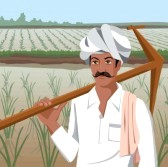
In the 1960s, India was facing  a severe food shortage. The Indian economy was decimated by 200 years of colonial rule and the 3 wars fought after gaining Independence in 1947. The country was struggling to grow enough food to feed its people and did not have the resources to import food either. Finally, it was food aid under the US PL480 program that enabled India to to stave off the threat of starvation for millions.  It was in this situation that India decided to adopt Dr. Norman Borlaug’s newly developed variety of medium wheat and what is known as the Green Revolution got its start. As productivity increased, so did rural incomes and many lives that might have been lost to famine were saved.

Despite the criticisms that have since been directed at this program, the enormous good that it did cannot be denied. This video captures the sense of what the adoption of this technology meant to India. While it highlights Dr. Borlaug’s efforts, what struck me most was the enthusiasm of the farmers for innovation, the openness to technology and the unsettling awareness that the path to adoption of technology today may be more difficult. Fifty years ago the decisions about farming were the domain of the farmer who had the knowledge to make those decisions, today the scenario is fraught with those who trust neither science nor those who have grown our food for years (in the case of Indian family farmers, this would mean over centuries!).

Home is Where the Fish Are

fish

As I try to meet the packing deadline for a month long trip back to see my family, two images float in my mind’s eye: one is the monsoon rains bursting down and the other is my mother’s plate of steaming rice and fish curry waiting at my place at the table. While most people today are familiar with Indian food, cuisine from the state of Bengal is less well known. Bengalis are obsessive about their food and there is a strict code to the cuisine: the order in which dishes are to served, what is cooked in which season, which vegetables with what fish; the list goes on. In the old days, young girls were grilled on their cooking skills as part of the arranged marriage interview! Above all, Bengalis adore their fish, abundant in the rivers and ponds of the lush delta the Ganges river forms before tipping into the sea. And of all the fish in the world, the most precious is the “ileesh”. This used to be  the fish of celebration, on festive days, weddings or if India won at cricket!

So reading about the beloved ileesh  vanishing from the earth is liable to stop the Bengali heart.But that is exactly what seems to be happening now, ileesh is growing scarce and Bangladesh (which became a separate country later, but was originally a part of India and shares the language and cuisine of Bengal) has banned ileesh exports. At the root of this is that all too familiar, tawdry tale: we abandoned the code of cuisine which treated the fish with reverence, ensuring that it was used sparingly, never eaten during the egg laying season. Now, we demand it all the time, in ever increasing quantities, even freezing it great chunks of ice to be sent to distant countries. There, it is defrosted, prepared as best as possible, and though completely devoid of flavor after it’s  arduous journey to the plate, still revives memories of home and family, far from the paddy fields.

On a more somber note, this year also marks the 70th anniversary of the Great Bengal Famine of 1943 which took about 3 million lives.  World War II was on, and the harvest was diverted by the British toward the war effort while the  people who worked to produce the food were ravaged by hunger. An outstanding film on this famine, “Ashani Sanket” seen through the eyes of  people in a village, was made by Satyajit Ray. It is often named as one of the best films ever made and I was a young girl when I saw it but still remember some scenes with much clarity: the lush green fields contrasting with the desperation  and degradation of the villagers, forced to sink to unthinkable levels in their search for food.

Posts might be a little infrequent during the next few weeks…..whatever I can manage in between bouts of food coma! Wishing you all a lovely summer!


Bananas for Mother’s Day

mother

Flowers are traditional, yes, but this Mother’s Day I am thinking about bananas. Specifically, the plan to grow iron fortified bananas in India.This plan, predictably, is being met with resistance in some quarters. But, first, some background: India is the world’s largest producer of  bananas and almost all of it is consumed domestically. India also has a very high incidence of anemia. The India Human Development Report 2011 noted that approximately 55-35% of women in the age group 15-49 were anemic and this number had increased  by 3% from 1998-99.  Anemia in pregnant women increases the possibility of pre-term or low birth rate babies. It also implies less than optimal development in utero which means that the physical and mental development of  a new generation is impaired and the cycle of poor health outcomes continues. We also need to consider  a new variable in all of this: climate change.  It is predicted that climate change will have critical impact on maternal and new born health from adverse environmental consequences. It would make sense, therefore, to give special attention to improving maternal health before the worst of the crisis is here.

Given this scenario it makes sense that the Indian government has approved a project for the transfer of technology from Australia to grow iron and nutrient fortified bananas. Bananas, grown locally and easily available, would be an ideal way to meet the nutrient needs of women suffering from anemia. And  where a busy mom pressed for time may not have time to prepare an iron-rich dish separately, she can always grab a banana on the go.

It has, however, been met, with resistance from groups that claim that the “indigenous biodiversity” which is supposedly sufficient for India’s nutritional needs will be “destroyed” and suspect a plot by dark forces to take over the banana domain in the country which is the biggest producer of the fruit. Well, if the indigenous bounty of nature would have been sufficient, we would not be facing these alarming  health statistics. Clearly, women’s diets still remain nutrient deficient and this needs to be addressed. The indigenous variety does not have the same iron content as the fortified one, of course, and none of these critics seem to have suggested any options for either increasing access to indigenous bananas or meeting the nutrient needs in any other way.

To understand the threat to biodiversity, I started researching banana cultivation and found that this is done by planting stem cuttings, so the possibility of threat to the native species is hard to discern. The other fear that this will result in “monocultures” is not a significant one because the most widely eaten banana on the planet is already the Cavendish, the kind familiar to us from grocery stores. In addition , some local varieties are grown in several countries but one variety of banana seems to be dominant already. The technique to fortify bananas already exists and we can speculate that the time taken to bring the fruit to the market would not be that long, so that some improvement in health outcomes might be expected despite the expected adverse impact of climate change in the coming years.

Along with the adoption of fortified bananas,efforts should also be made to revive indigenous iron rich crops which have been overshadowed in recent years.This is not an either/or situation, we can and should take advantage of all the solutions available to us. Certainly we need to protect biodiversity but we cannot overlook the health of mothers and children which will determine how strong our next generation will be. An interesting example in this regard is that of Uganda: faced with banana wilt which was destroying crops and could have resulted in the abandoning of banana cultivation, scientists have developed a variety with a sweet pepper gene which stays can combat banana wilt. Better a GM banana than none at all in a country which prides itself on its banana tradition.

Just like biotechnology, the celebration of Mother’s Day in India in recent years is sometimes criticized  as a western import, alien to indigenous traditions. So it is fitting that my wish for all the moms on this Mother’s Day is that India does grow fortified bananas and we have healthier moms and babies in the future.