
New Day, New Diet Trend

The Mediterranean Diet, long known as the “ideal” diet to follow , is problematic for those who live in countries where some ingredients, olive oil for example, are not readily available. So, researchers in Norway, Sweden, Iceland, Denmark and Finland came up with a dietary regime based on local foods and tested the results on two groups of people: one of which was put on the local foods based diet with the added rule of no red meat and no sugar; and another which consumed red meat and white bread as is normally done in these countries. Not surprisingly, the people in the first group showed an improved good cholesterol/bad cholesterol ratio and also changes in a marker for inflammation.
The benefits of a diet based on local food are not only financial and environmental but are also reflected in improved health outcomes as we eat the diet best suited for the conditions in which we are living. But pursuing the goal of local eating alone is not enough, even better is to eat in season. When we explore, as this chef did, what is actually growing around us, we will discover foods we did not even know existed. Case in point: I could not have identified the greens in the image above last month but have just discovered how delicious these garlic scapes can be! This is the top part of the plant, we normally use the bulb, and; here is the best part: by using every bit of the plant we reduce food waste and crucially, a waste of the water that went into growing that plant.
Posted in Food Choices, food fun, Green, Living
Tagged food decisions, food fun, Green, Living, nutrition
Corn crops — what a difference a year makes
As part of Thought+Food’s close look at the journey of our food, I am hoping to highlight the very beginning and this account of planting corn on a family farm provides an insight into that world which is particularly interesting for the urban consumer.
Posted in Uncategorized
The Mystery of the Suddenly Appearing GM Wheat
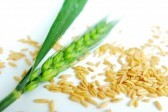
You have been reading about the sudden appearance of GM wheat in a field in Oregon, the ongoing USDA investigation into how it appeared there, the possibility of a boycott of American wheat by countries worried about GM wheat in their food supply, and the possibility of stiff losses to farmers (90% of Oregon wheat is exported). However, being a member of that vast group, Clueless Urban Consumers, you held back on giving your opinion on social media because you were discovering a whole new world which you knew very little about , and did not feel comfortable asking out to the world the questions burning in your brain: for instance,” where do baby wheat come from anyway?”; and, “wait, what, there are different kinds of wheat?”
Here is something to start with: wheat is not pollinated by insects, it self pollinates inside the flower while the flower is closed. Why is this important? Because bees or insects flying around cannot carry pollen to other wheat plants and enable cross pollination. The pollen is heavy and cannot be carried far, anyway. Extra pollen may fall to the ground but is not viable for long so the possibility of pollen in soil getting moved to the field planted with regular wheat is remote.
There are several varieties of wheat and the distinctions are important. The wheat grown in Oregon is soft white winter wheat, bought by Japan and Korea where it is used for noodles and crackers. There is also, “hard red winter wheat, “hard red spring” “hard white wheat’ and keeping all these varieties separate is a special concern of wheat growers and there are associations on every state to ensure that correct procedures are followed.
Now to the incident in question. A farmer in Oregon discovered that some wheat plants in his fields were resistant to glyphosphate and contacted researchers at Oregon state University where it was determined that this was indeed, genetically modified wheat. GM wheat was tested by Monsanto from 1998 to 2005 and last grown in Oregon in 2002. Monsanto then withdrew the application and closed the trial. After this, proper measures should have been taken to deal with the seeds and other materials from the trial. (It is important to note here that this GM wheat had been certified safe by the FDA, but before the deregulatory process could start, there were threats of international boycott, protests etc so GM wheat never came to the market). Also worth noting, Monsanto is currently testing GM wheat in Hawaii and North Dakota.
So if I have understood all this correctly, some questions arise. The obvious one, how did the GM plants get to this field? No one, wheat growers, scientists, or even those opposed to GM technology else has a plausible explanation of how this wheat could come up, years after testing had stopped in a field which has been cultivated regularly without any previous occurrence of GM wheat. GM corn and soy are widely grown in the US so logically there would be a higher probability of these sprouting randomly than wheat.
And that brings us to some notable observations: if I wanted GM technology to vanish overnight or even scare the population enough to push through my agenda of labeling everything in sight, what crop would I pick to create a fuss over? One that had already been the object of controversy which lead to abandonment of the GM version, (and , double bonus, the GM version was being tested by the company that has been made virtually synonymous with biotechnology in agriculture by anti-GM groups), one which forms a huge share of exports and is essential to the livelihood of many people , one where the distinction between varieties is crucial, one that would stir international controversy: wheat is the perfect answer. Is it possible that this is not a random occurrence?
While we wait for for the USDA to publish its findings, it is important to remember that even if this wheat entered the food chain it is perfectly safe for human and animal consumption. So there is no reason for panic. All this does is stir, once again, the pot of fake science and fear that some people cannot seem to let alone. Let us take a step back and understand this: every time fears are raised and technology is abandoned, farmers and consumers, specially in the developing world, lose options. There is so much noise about GM seeds being expensive, well, look at how expensive the process is: if GM wheat ever comes to market the whole process would have taken decades, and who has the resources to stay the course over that period of time? Not universities or governments or research institutions but, you guessed right, a corporation like Monsanto.
Posted in Farm Technology, Food Policy, Food Safety, Food Security, Green, Hunger
5@5 — Why printed cookbooks still matter
Do you prefer real cookbooks or the e- version? I must confess to cherishing the real ones that I have but do look up lots of stuff online!
Posted in Uncategorized
“I Have Measured Out My Life With Coffee Spoons”

T.S.Elliot spoke for so many of us when he wrote that, but now, this warm indulgence so crucial in equipping us to fight the cruel world is under threat. Coffee plants in Central America face the possibility of being wiped out by a pathogen called Coffee Leaf Rust (Hemileia vastatrix). This pathogen was earlier responsible for the devastation of coffee plantations in Ceylon. Is there a way to avoid this? Yes, it can be dealt with by using a synthetic fungicide called Triazaline. The problem? Coffee drinkers in the US and other prosperous countries want their coffee to be organic. The organic fungicide that is used by farmers who grow organic coffee is copper based, much less effective and the run off from the plants poses environmental problems. Most of the organic coffee is grown by smallholder farmers who would lose their organic certification if they used the synthetic fungicide. However, if they had the option of using the synthetic fungicide solely in order to deal with this crisis, they could save their crop (coffee is grown from seeds which could be saved from the current year’s crop) and be re-certified after 3 years. But faced with the consistent insistence on the organic label, these smallholder farmers may have to lose their livelihood.
How important is the “organic” label anyway? We already know the organic fungicide is not a good option. For farmers to receive certification, they have to pay stiff fees which puts a huge burden on them. Unless the coffee is shade grown, it means forest cover has been cut down to make way for farms (even organic ones) which is not environmentally optimal. Often, middlemen buy from the poor, smallholder farmers paying them a fraction of what this coffee will eventually earn in a market driven by the drinking tastes of consumers who remain unaware of the ground reality of those who produce the coffee.
Colombian coffee growers with the help of their government were able to eradicate leaf rust. Could these results be replicated elsewhere? I am still trying to research what methods were used there. Accessible and detailed information on the leaf rust issue is here at Applied Mythology. Solutions are available, the outcome is not inevitable. In this as in so many problems with the food system today, two things are essential: first, the voice of the farmer has to be heard on par with the consumer; second, a pragmatic perspective that brings us a good outcome for all and not just a few privileged people. Otherwise those coffee spoons might just be left there, unused…
Posted in Farm Technology, Food Justice, Food Policy, Green, Living
Tagged Farming Technology, Food Justice, food policy, Green, Living
Canned Peaches As Good As Fresh?

The answer to that is “yes”! A new study finds that there is no difference in the nutrient content between canned and fresh peaches. In fact, canned peaches offered more folate and Vitamin C because the canning process opens up the cell walls so nutrients are more readily available, the report on NPR says. What does this mean for us? First, the good news is that we can eat peaches throughout the year without feeling bad that they are somehow deficient because they came from a can. Of course, it is always better to get the kind that are packed in their own juice instead of syrup and thus eliminate extra sugar from our diet.
Let us also acknowledge that they are never going to taste like fresh peaches but in the depth of a dark and snowy winter they still will evoke a memory of glowing summer days and there is certainly something to be said for that. Also, if we eat in season in summer and then use the canned variety in summer, we avoid the temptation to pick up fresh peaches in winter which have traveled half the world to get here and they are not anyway going to taste anything like the juicy peaches which will soon flood stores and farmers’ markets.
There still are concerns over the use of BPA in cans which could be also in the fruit we eat. I remember the first time I saw a report on the possible harmful effects of BPA on TV and looked in horror at the baby bottle I was rinsing at that moment. However, there is new research which shows that earlier conclusions reported in the media may have been unnecessarily alarmist. The findings are summarized in an accessible way in the link above and although they do require some effort from the lay reader, I would recommend reading it to understand the analysis.
Now, time to get my peaches on the grill to go with the ice cream! Happy long weekend!
Posted in Uncategorized
What do Farmers Really do?

One of the startling features of the ongoing debate on the food system is how skewed the conversation is in the direction of the consumer. We hear a lot about food safety concerns, the right to know what is in the food, how it should be grown so that health concerns are addressed; but how many times do we hear from the people who are actually growing the food and who can provide a reality check on demands that sometimes seem to originate in the realm of fantasy. ( This rant is prompted by a tweet I saw where a consumer demanding safe food reportedly said that all farmers wanted was to dump some Roundup Ready on their fields and put their feet up!!).
For all those marching and demonstrating to make the rules about what food should be grown how many have actually worked on a farm? It is not fun and it is nothing similar to raising tomatoes in the back yard or even working on an allotment. Consider this information from the Cherokee Gothic blog:
“In 2011, the unemployment rate in North Carolina was quite high at 10.51%, which meant that there were more than 489,000 American workers in the state actively looking for a job. Of that group, only 268 were asked to be referred to manual labor jobs with the North Carolina Growers Association (NCGA). And of those 268, only 163 showed up for work. This gets us to striking finding #2. Of the Americans that did start work, only 7 finished the season.”
So even when faced with no other means of making money, people were unwilling to do farm work or did not have the stamina to actually cope with it. Or, consider that crops were left to rot in the fields in the aftermath of anti-immigration measures passed in Georgia and Alabama because there was no labor available for the harvest.
The reality is farm work is demanding and exhausting and that there is a scarcity of people who want to work in the farm sector and the challenge is to make this an attractive area for younger people to choose to make a livelihood. Let us take a moment to reflect on what goes into growing the carrot that we reject because it has a little bit sticking out; or the corn fields that are burnt instead of feeding desperately hungry people simply because they were GM corn.
6 Genetically Modified Foods That Changed the World
Clear, accessible information that is crucial for everyone to know.
Posted in Uncategorized
Forget the IRS — There’s an Olive-Oil Scandal Afoot
Summer is almost here, all those salads and veggies on the grill are going to need some olive oil but here is something we need to read about that…
Posted in Uncategorized
 Thought + Food