Sometime ago I wrote about the drought in Syria that had been an underlying cause of the unrest there. Here is some news now on the farmers who are trying to make a new life in Lebanon. While some of them used to come in as temporary workers in the past and are now moving for good, some people are fleeing the violence and taking up farming jobs to support their families. Life has also changed for the farmer in Lebanon who finds it difficult to market his produce but the stories of the woman who has planted a few flowers because she misses her garden back home; or the girl who dreamed of being a doctor one day are poignant.
Why Soils Matter in the Global Food Security Debate
Informative read on something we tend to forget or even take for granted!
Some of you may know (although I have to confess that I was personally unaware until yesterday) that last week was ‘Global Soil Week’ when more than 450 scientists, policy makers and practitioners from 71 countries gathered together in Berlin to discuss the role of soils in society. The theme of the week was ‘Losing Ground?’ and many topics were discussed including the economics of land degradation, which strategies to use to ensure the sustainable use of soils and land in order to achieve water, energy and food security and how best to manage soil in a sustainable manner?
Reading about the week has made me realise that I haven’t yet discussed ‘soil’ explicitly on thinkingcountry. I am currently writing an undergraduate dissertation thesis on earthworms and whilst I personally find them and their soil environments endlessly fascinating, I realise that many people see the ground beneath our feet as…
View original post 701 more words
Posted in Uncategorized
How to Understand a “Study”
“Studies have shown” or “a recent study concludes” or a “survey of studies indicates”….how many times do we read an article on food safety or policy which includes these time? All the time! But what does this really mean? How do we as lay people try to understand them and formulate our own understanding? Here is an excellent piece on just that topic from the Biofortified blog (which also has tons of other informative stuff): http://www.biofortified.org/2013/10/making-sense-of-lists-of-studies/#comment-227677
Reading the studies then gives us an idea of how complex the issues at hand really are and reducing them to slogans/memes is not useful. We have to be prepared to bring our full attention to food issues and also acknowledge that there are experts who would know more and be prepared to respect that as well.
Posted in Uncategorized
Just Label It!
I watched the GMO labeling debate closely in California and cheered when the proposition was defeated there. But when I read the arguments from the pro-labeling side,(based mostly on misinformation and unsubstantiated fears) I began to think that blocking labeling is perhaps not the best strategy. GMO foods, it has been proven, again and again, are safe for human consumption. The pro-label lobby has therefore, framed the debate in terms of the “consumer’s right to know what is in their food”. It is hard to make the case that the consumer should not know/does not need to know what is in their food and so, blocking labeling makes it seem like the producers of food containing GM ingredients are hiding something. One would like to ask the question: how would knowing this be useful to the consumer anyway? If they do not want to purchase GMO products, there is already a label for them: it says “organic” or that fascinating mystery term, “natural” which many seem to rely on.
It is important to remember that this debate is being played out in parts of the world that have the luxury to debate about food. In other areas, where people are going hungry every day, children are malnourished and suffering from dietary deficiencies, food on the table is a survival issue. Biotechnology offers a way to combat global hunger. By blocking labeling and letting the “there is something to hide” misinformation gain ground, we are denying choices precisely to those who are most vulnerable. If we continue to block labeling, the ultimate aim of the anti-GM lobby; to take biotechnology out of the options forever, would be achieved and this would be a disaster in the struggle to deal with hunger and malnutrition.
Instead, imagine a situation where the labeling issue is actively owned by those seeking to make sure the benefits of GM foods actually reach the public. Companies need to proactively steer the labeling issue in a positive direction: uniform labels for the whole country so that the same chaotic battles do not have to be fought over and over again in each state, providing more opportunities for spreading misinformation. The actual words on the label are crucial and that should not be dictated by the naysayers. Ideally, I would propose :”This product contains GM ingredients which have been more rigorously tested than most products in your grocery store. They are produced using less pesticides and so are better for the farmers who grow them and our planet. They are also fortified with Vitamin A (for example) which will prevent blindness and death in millions of children.” But that is a dream and in the real world, companies will have to work hard to merely ensure that negativity is minimized.
In purely economic terms, there is a far bigger market out there as measured by currently undernourished/malnourished people than the few who might switch from buying products post labeling. And, most important to remember, the one piece of information on the label which seals the deal for a consumer on a budget is the price.If there is an initial cost increase involved, companies need to refrain from passing that on immediately to the consumer. Instead, let them read the label, see the price, compare it to the high priced organic option and make their decision.
Posted in Food Choices, Food Policy, Food Safety, Green, Hunger, Living, Nutrition
Tagged food decisions, Green, Hunger, Living, nutrition
GMOs: The View From Italy
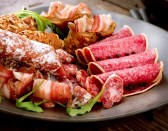
Absorbed as we tend to be in our own food system battles: food safety, labeling, etc; we tend to forget that similar struggles are taking place elsewhere. I always tend to think of Europe as solidly anti-GM although, there is a lively debate on right now in the UK, for example, on the adoption of GM technology. So, this piece on the import of GM corn by Italy was illuminating. First, the elaborate dance around growing/importing GM corn even when the current corn crop has been devastated by pests is entertaining to read. Also, I learnt that several countries in the EU do grow or import GM crops, somehow working through loopholes in the regulations banning this technology. And, finally, a familiar picture: no one is listening to what the farmers have to say. The final scene in the drama played out thus: Italian pigs will be fed GM corn imported from the US (but what will this mean for future prosciutto?!), while Italian farmers are left to deal with the consequences of a failed harvest. Too bad they cannot blame it all on Monsanto!
Posted in Farm Technology, Food Choices, Food Policy, Food Security, Hunger, Living, Nutrition
Tagged Farming Technology, food decisions, food policy, food security, Hunger, Living, nutrition
Great Moments In Fact-Checking
This was interesting….
Many of Snapple’s “Real Facts” aren’t facts:
Elephants actually sleep three to seven hours a night, not two (#35), according to the San Diego Zoo. The Statue
of Liberty wasn’t the first electric lighthouse (#179); that distinction belongs to the Souter Lighthouse, according to the UK National Trust. And the average American doesn’t walk 18,000 steps a day (#89), not even close. The real tally is more like 5,116 steps, according to a recent study.
Other “Real Facts” are misleading or outdated. A mosquito doesn’t really have “47 teeth” (#50); it has a serrated proboscis — the sharp tube used to suck blood. Pennsylvania isn’t really misspelled on the Liberty Bell (#300) because “Pensylvania” was an accepted spelling in the 18th century, according to the National Park Service. And while the Mona Lisa has no eyebrows (#85), it’s not necessarily because she was painted that way. They just eroded…
View original post 75 more words
Posted in Uncategorized
The Shutdown of Reason
Things have been quiet on the blog recently. I had some volunteer commitments take up more time than I expected. All the while, I was watching the shutdown drama and thinking how much this resembled the tantrums of the children in our project. The potential for disruption on the national scale is, of course, much larger but it is still seems like we are seeing a situation where reason and logic do not work. What issues are so crucial that the lives of people are held hostage? That is what happens when food safety programs are stopped, and there is a salmonella outbreak. Or what about the uncertainty in markets in the absence of reliable data and price signals as in the case of the hog market here? As we lurch further into the dark one wonders how it came to this low point. Is this the same farming system based on scientific knowledge that the Economist describes admiringly, that continues to innovate with great ideas, now condemned to chaos because the Farm Bill has (again!!) expired?
Posted in Uncategorized
Pumpkin Time is Here!!
Happy Fall! In the US this is the time when “pumpkin flavored everything” hits the stores. The first time I heard of Pumpkin Spice Latte I did wonder “pumpkin and coffee…???” The reality is that its more about the spices associated with pumpkin: cinnamon, nutmeg etc; rather than the pumpkin itself, which brings in the pumpkin factor at this time of the year. Check out this link to know which of your favorite treats actually contain pumpkins.
Who Feeds the World?
NPR’s “The Salt” blog had an interesting piece today on a phrase that gets used a lot: the assertion that American farmers “feed the world”. As often happens, the real fun starts in the comments section. People who have, perhaps never grown anything in their backyard and may have never even visited a farm feel free to weigh in and dispense advice! So, they assert, that American farmers are actually forcing the rest of the world to eat nutritionally poor food grown in a way that is harmful for the environment.
While there is room for improvement, the reality is that most farmers are mindful of the environment and try to grow food in a sustainable way. Of course, big agribusinesses came up for criticism as well. But what was interesting was the perspective of most commentators was so narrow. To a family struggling with drought and famine and unable to feed themselves, a sack of grain, however imperfect, is a miracle. And sometimes, that grain comes from America, simply because there is extra that can be shared or because of abundance it sells for a lower price.
It always amazes me how people think that simply because we all eat food we are competent to pass judgement on those who actually grow it!
Posted in Uncategorized
Drought, Hunger and Syria
Looking at the news these days, it seems that the world is just coming apart and understanding all of this is impossible. But it is also difficult to turn away from, so I started reading this piece to learn about the situation in Syria. And when I came to point 6, I had to stop and read it again. How did I not know this already?
There was a severe drought in Syria from 2006 to 2011 which disrupted the rural economy. Lack of water meant that farmers lost their livelihoods and migrated to the cities to get whatever jobs they could, to keep their families from starving. The Syrian government, meanwhile, decided to sell off the grain reserves. Already unsuccessful in dealing with the drought crisis, it now had no food to offer its citizens and had to import food. This, obviously, was not a viable solution and it is easy to see why violence, fed by this and other factors, has broken out.
Two things come to mind here: the issue of climate change and the breakdown of Syria’s food production system has largely remained invisible in the discussions on military action. How could a calamity that resulted in an estimated 2 to 3 million people being reduced to “extreme poverty”, have remained unnoticed? And, for the future: as the impact of climate change on our food system becomes more intense; this situation ,with minor changes in variables, could be repeated across the globe. What will we do then?
It is time to put the food system at the center of any debate on the future. If we talk of dealing with climate change, let us start by recognizing its crucial impact on how we grow food, if we want a more equal world, let us ensure that its roots lie in a just and fair food system, and if we want a secure world, food security needs to be the first step.
Posted in Climate Change, Food Policy, Food Security, Hunger
Tagged climate change, food policy, food security, Hunger


of Liberty wasn’t the first electric lighthouse (#179); that distinction belongs to the Souter Lighthouse,