Feed a Child, Nourish a Mind: My Post for The Lunchbox Fund

Lunchbox Fund Photo 3

Everyday children go hungry all over the world. Not just in poor countries but even in places which seem to be rich in resources. These children might make the trip to school but are too weak to learn because their bodies and minds are  deprived of nourishment. Just when children are excited to hear about snow in the forecast bringing a day off from school, others cry because they will miss their only meal of the day.We think we feel their pain but nothing in our daily lives quite prepares us for the child who sits apart from others at lunch because watching other kids eat makes the pangs of hunger even harder to bear.

The Lunchbox fund is an initiative in South Africa to provide lunch in school to children who would otherwise go hungry. 65% of  children in South Africa live in poverty, 20% have been orphaned by AIDS; without parents and without food they are likely to slip out of school into a bleak future. This week, The Giving Table (http://www.givingtable.org/#home) has organized a campaign to support  The Lunchbox Fund and I am proud to donate this post toward this effort.

The theme for bloggers donating posts is lunch. In keeping with that, I thought I would share my story of packing lunch for my kids. When Kid 1 started school, we agreed that she would buy lunch on one day, usually on Friday when pizza was offered and the rest of the days I would pack lunch for her. Mindful of children with nut allergies, the school prohibits peanut butter but other than that we experimented and tried out every kind of sandwich filling we could imagine and my child was happy to eat sandwiches everyday. I would listen to the complaints of other parents about packing lunch for a picky eater and be thankful for my blessings. Then came Kid2 and my world turned upside down: the lunchbox would come back almost just as it was sent out, sandwiches were boring, pasta was “too cold”, chicken smelled “funny”, I just could not get it right.

Desperately searching for a solution, I fell back on the lunches of my childhood, the soft rotis , the delicious stuffing that my mother would roll up in them; and I decided to try and replicate it. Since Kid 2 is constantly vowing to become a vegetarian “from my next meal”, I have to chosen a simple and easy vegetable dish that makes the lunch nutritious and yummy.

IMG_0008

Easy Indian Vegetable Medley

Ingredients:

1 onion

1 potato

1 carrot

A few green beans/flat beans

2 or 3 stalks of cauliflower/broccoli

1 green chilli

1/2 tsp cumin seeds

1/2 tsp turmeric powder

Salt to taste

Method:

Slice the onion finely. The vegetables should be chopped fine, length wise. This ensures that all the ingredients are roughly the same size and will cook at the same rate so none are left too raw or overcooked. Any combination of vegetables will work but I have included our favorites, sometimes I have only two or three of these to hand but the recipe works just as well.

Heat oil in a pan. Keeping the heat at medium, add the cumin seeds (these are available at all Indian grocery stores and many regular grocery stores as well. if you do not have them, you can still go ahead and make this). When the seeds are toasted, they turn a darker shade and it is time to add the onions. Let them cook till they are soft and then add the vegetables. Toss all the ingredients together and let this cook for 2-3 minutes, stirring occasionally. Then add the turmeric (availability same as that of cumin) and salt ,and mix well. Cover and let it cook for about 5-7 minutes. Take off the lid and check to see if vegetables are tender but not mushy. At this stage  you can add the green chilli, sliced in half, for a little bite if you like. Increase the heat and cook for a minute so the vegetables are crisp and bright.

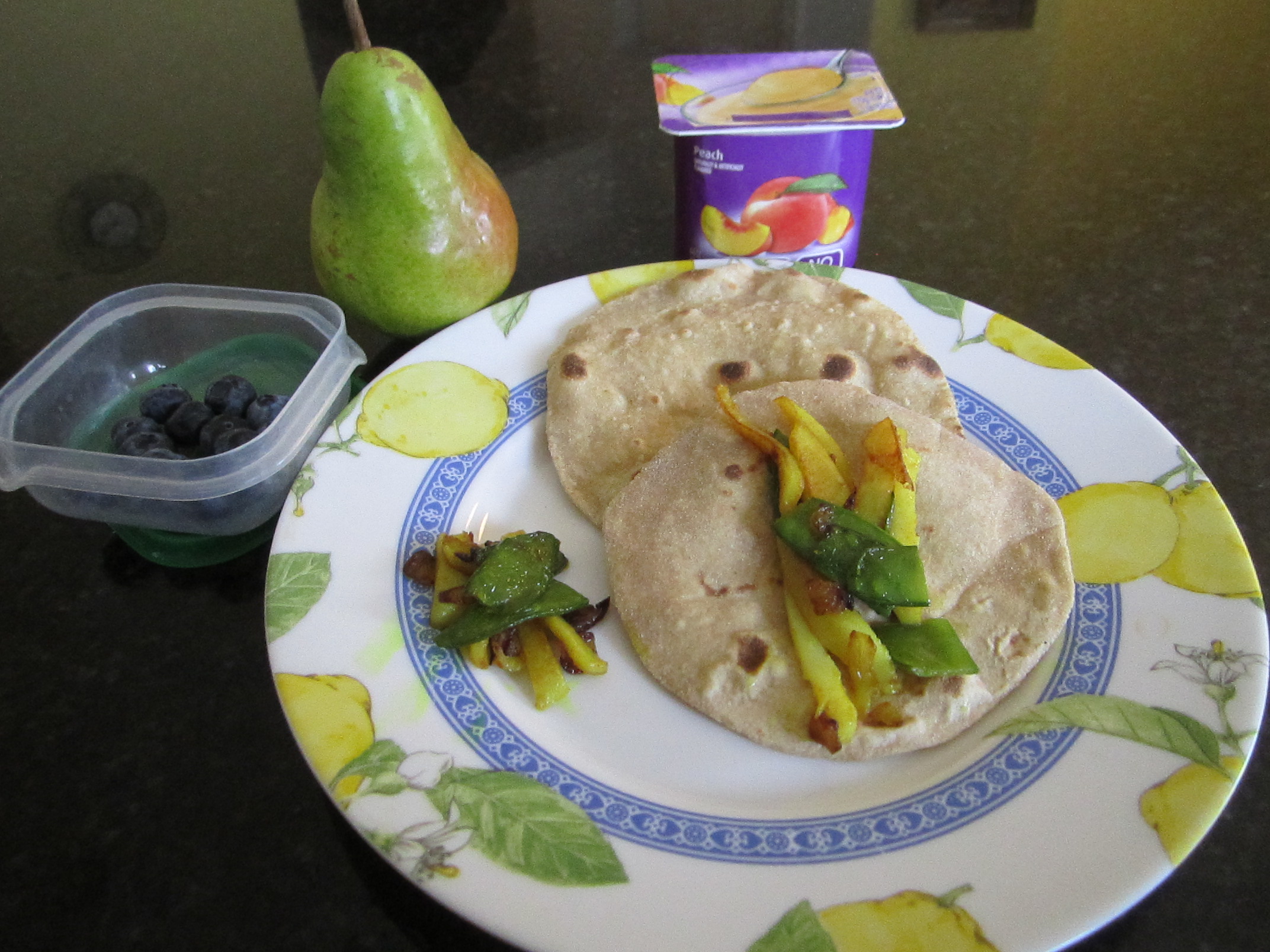
I usually roll this up in a roti  made at home with whole wheat flour. This can also be purchased at the Indian store or substituted with tortillas. Since the school day is long, this is supplemented with fruits and yogurt. Often, this is what I have for lunch as well.
IMG_0012

The campaign runs through this week and even donating my weekly coffee budget would make a difference,  and I certainly intend to do so.We have many choices for lunch, I intend to share this good fortune with those who have none and  make a donation here.Please do consider it as well.


All you Want to Know About the Farm Bill

farm


Since my last post was about the one acre farm, I am not posting for Framing Friday but decided instead to provide a recap on the Farm Bill which, as you might remember started life as the Farm Bill 2012, had some near death experiences, spent some time as a zombie and had now been restored to life as the Farm Bill 2014.

It is important to remember that given this disastrous past, it is something of an achievement that the bill finally got passed, at all. Sad commentary on our times! And, the news is not all bad. Yes, there have been cuts on conservation spending and food stamps but direct payments have been replaced by an extended crop insurance program (there will be no more “over the dairy cliff” scares) , a plan to double food stamps when used at farmer’s markets and investment in renewable energy, research, specialty crops, to name a few.

Hopefully, the good things will take root and give a good foundation to agricultural policy.

Here are some useful links:

http://www.washingtonpost.com/lifestyle/food/farm-bill-contains-farmers-market-program-that-food-advocates-for-poor-see-as-hopeful/2014/01/30/b86c9b74-89e3-11e3-833c-33098f9e5267_story.html

2014 Farm Bill Drill Down: The Bill by the Numbers

The New Farm Bill: The Good, The Bad, and the Wait-and-See


The Brutal Math of the One Acre Farm

We hear a lot about industrial farming and big farms but what happens if all the farmer has is one acre? Can he/she make a successful livelihood? A small change in variables, it seems, can bring about a big change on the one acre farm and in the life of the farmer.

Francisco Toro's avatarCampaign for Boring Development

As facts go, the facts of the small African farm are grim, and seldom grasped. You need to start here, though, because 70% of the world’s poorest people live on very small farms.

Their poverty is nothing but straightforward: if you’re farming the size of farm the poorest farm, with the kind of technology the poorest have access to and getting the yields that pass for normal in the poorest countries, you just don’t produce enough calories to feed  even two adults –

[A note on sources is at the end.]

A household working one acre at South Sudanese yields just can’t feed itself. Notice, we’re talking calories here. So this is before we even start thinking about protein, or micronutrients, to say nothing of the thousand other things people need to survive (cookware, salt, oil, housing, clothes, etc. etc. etc.) It doesn’t get more elemental than this.

The second column…

View original post 379 more words

#Farming Friday: Who Controls the Seeds?

seeda

One of the issues in the GMO debate that seems to concern people a lot is that of corporate control over seeds. In today’s Farming Friday, a  farmer talks who uses both GMO and non-GMO seeds talks about his choices and decisions.

Image Courtesy: Freedigitalphotos.net

What Are We Really Paying for Genetically Modified Food?

money

There is the science of GMOs, there is the fear and hysteria over GMOs but where are the numbers on GMOs? In other words, what does it cost us to delay or forgo the adoption of this technology?

Consider this: according to World Bank estimates ,the Maternal Mortality Rate in India is 200 (MMR is the number of women who die during pregnancy or childbirth per 100, 000 live births). Compare this to China (21) or Germany (7) and clearly there is a long way to go. One of the main causes of a high maternal mortality rate is iron deficiency anemia. Yet the possibility of bringing fortified bananas ,developed in Australia, to Indian consumers to address this issue was blocked by anti-GMO groups.Here was the possibility of improving health outcomes,  not only  at birth, but in the life cycle ahead as children born to anemic mothers are more prone to stunting. The number of lives lost/negatively impacted by this blockade is not going to be a small one.

While we do not have exact numbers for that story, a recent study has looked into the actual cost of the delay in making Golden Rice available in India .  The study looks at the perceived costs of adopting Golden Rice ,and  how raising doubts about the benefits makes these perceived costs larger and the ultimate cost to the country. In this case, the opposition to Golden Rice and delay in its availability to those suffering from Vitamin A deficiency was estimated at  1.4 million life years over the past decade. The paper can be read in its entirety here.

From another perspective, here is a study which calculates the impact of foregoing growing GM crops like corn, soybean and canola. The yields for these crops would fall, prices for these crops and their derivatives would be 5%-9% higher , prices of related cereals and oil seeds would also be higher by 3%-4%.

This is merely a pointer to the issue at hand and I would like to emphasize that the studies should be read in full to understand that there is a real cost to delaying or opting out of adoption of GM technology. It is, of course, much easier to go the “GMOs kill Butterflies” route than actually follow the data and the equations: one reason why talking about the food system is so fraught!

Farmers’ Markets Dwindling in Paris

bag


Yesterday I discovered that Italians are no longer cooking at home like they used to and today I learn that those wonderful farmers markets of Paris are disappearing! Truly, the world of food is not what it used to be.Again, why? what has changed and led people away from the fresh produce, breads and cheese of the neighborhood market to the all in one hypermarche? Perhaps it is convenience, we are all pressed for time these days, or perhaps tastes have changed….

Have you been traveling or relocated and found the local food culture to be different from what is generally known about that country/region? If so, I would love to hear from you!


Do You Microwave Your Pasta?

pasta


No need to feel guilty, though, because even the Italians are doing it now! Yes, the land of  fresh tomatoes, cheese and olive oil is succumbing to the allure of processed food, sodas and even MacDonald’s . All this I discovered on reading this excerpt from a new book “The Lost Art of Feeding Kids: What Italy Taught Me About Why Children Need Real Food”  by Jeannie Marshall.

Apparently, only old ladies go shopping for fresh groceries, most adults do not cook  and children are drinking Coke with their pizza. All this was interesting but what I was dying to know was: why? why has the Italian lifestyle become so much like the American one? Does the book provide an answer? No clue but if you read it, please let us know!

Image Courtesy: Apolonia, Freedigitalphotos.net

#Farming Friday: 3 Stories


I had a hard time trying to pick one story for the second post in the Farming Friday Series: there was a story about a beginning farmer trying sustainable methods (encouraging!), another farmer’s experience with precision farming ( is this the future?) and one delightful story,with gorgeous pictures, of a farmers’ market in India where people and their cattle come out in their colorful best and a wonderful time is had by all. So I included all three and you can decide which you like best!

Why GMOs matter — especially for the developing world

More on the series on GMO s at Grist-org, reading the whole series is well worth the time.

Water and Technology in Farming

irri

This post grew from a discussion on Twitter about the state of Indian agriculture. Why, it was asked , would young people, choose to work on farms when they could get less demanding and higher paying jobs in malls and call centers in the cities? Perhaps, technical innovations that would increase productivity and income might make farming a better career choice? Then it was noted that Indian agriculture continues to remain dependent on the monsoons for water and new technology might provide some solutions.   By a curious synchronicity I came across this article on Peruvian farmers using modern technology and older knowledge to deal with climate change that makes rainfall erratic.

The indigenous communities were struggling with new conditions which meant that rainfall came in short, intense bursts and the soil does not retain enough water for pastures or subsistence crops. The weather that they collaborated to collect with the aid of technology painted a bleak picture of an uncertain future for rural communities.The solution: to build water reservoirs similar to those used by the Incas.

What struck me most in this piece is the development and sharing of this knowledge by the community members themselves. Also, the recognition that this program is only a part of the solution. Climate change is going to require a huge and varied effort from all of us, from the farmer in rural Peru to those who are reading and sharing these stories in urban settings. There is no magic wand, no perfect solution, we must try all that we know (including genetic modification) without prejudice.

As I was writing this, I remembered reading about an app that alerts the farmer to when and how much water is needed. I had forgotten to bookmark the source so I decided to search for it and here is the first page of search results!  I had no idea that there was such an array of options available at the swipe of a screen! How accessible and relevant are these for the farmers in Peru or India? That will be explored in another post: do share your experiences and stories in the comments , it would be great to include those as well.

(Image Courtesy of FreeDigitalPhotos.net)