Tag Archives: Living

#Farming Friday 10: Farming in the Time of Climate Change

cl warm


“The glacier knocks in the cupboard,

The desert sighs in the bed,

And the crack in the teacup opens,

A lane to the land of the dead.” – W.H. Auden

Climate change presents a unique challenge to the way we live on our planet. Today’s edition looks at this from a farmer’s point of view.

Also, tonight is the first episode of “Years of Living Dangerously”. Please watch if you can, and share what you felt about the links between climate change and the food system.


“Years of Living Dangerously”: Climate Change in our World Today

cl3

Yesterday I watched the première episode of the series “Years Of Living Dangerously”. I had heard a lot about it and was curious to see if it would touch on  any links to agriculture/food system. It started off with Harrison Ford, one of the celebrity correspondents helping to tell the climate change story, taking off in a plane repurposed by NASA to collect samples of greenhouse gases in the atmosphere.  Other aspects of the story unfolded as we visited Plainview, Texas where long years of drought decimated the cattle and shut down the local meat-packing factory, rendering people unemployed; to Indonesia where centuries old forest growth is being cut down everyday to make room for palm oil plantations; and to Syria where the roots of the current conflict are traced back to a devastating drought that displaced farmers and forced people into extreme poverty. (I wrote about Syria earlier here).

The science of climate change is well presented and the most fascinating part of the hour, for me, was watching  Dr. Katherine Hayhoe of Texas Tech University explain how her personal faith and  her work in climate change coexist. Often, communication between scientists and the public is less than successful so it was great to see this work well here. The question of palm oil plantations is a fraught one and it points toward a very difficult challenge: getting people to change their habits. Palm oil appears as an ingredient in a variety of  products ranging from Nutella to soap and is crucial to the profit lines of many companies. It is these business interests which ensure that the burning down of forests continues (thereby releasing carbon into the atmosphere and lowering the ability of forests to absorb carbon) and they are strong enough to push their agenda ahead.  While disappointment and frustration at this situation is justified, I do think this part of the puzzle would benefit from a bit of reflection. If there was a time for calm conversation,for careful expression of opinions it is this time. Countries like India, Indonesia and others often complain about developed nations speaking loudest and that needs to be avoided in the interest of finding solutions for all. Going back to the habits issue: if the production side is intractable can we try to reduce consumption of products containing palm oil thereby reducing making it less profitable? That does not seem easy, either.

The piece on Syria connected the dots between  prolonged drought, the struggle for resources for survival, and social violence.From Turkey, across the border into Syria, we got a riveting glimpse of the people at the center of the struggle, people like the commander of Syrian fighters who used to be a cotton farmer and whose comment stayed with me long after I heard it: “Starving makes you do anything.”

This, then, is the future: unpredictable and severe weather events leading to a struggle for resources (land, water, food), spread of diseases leading to public health crises and escalating social conflict. What are we going to do about it?  We seem to be still arguing over who did what and when, while the clock is ticking down to disaster. Sure, adaptation and mitigation efforts are being made but as this article argues, a challenge like this deserves an extraordinary response. After all, the future of the planet and its people depends on what we do today.

This episode of “Years of Living Dangerously” left me wishing that it was available for all to see and not restricted to one channel. Based on how well made this episode was, I want to know all the stories. Indeed, I would have “binge-watched” it, if that were possible! In the meantime, you can watch the first episode online here.

Feed a Child, Nourish a Mind: My Post for The Lunchbox Fund

Lunchbox Fund Photo 3

Everyday children go hungry all over the world. Not just in poor countries but even in places which seem to be rich in resources. These children might make the trip to school but are too weak to learn because their bodies and minds are  deprived of nourishment. Just when children are excited to hear about snow in the forecast bringing a day off from school, others cry because they will miss their only meal of the day.We think we feel their pain but nothing in our daily lives quite prepares us for the child who sits apart from others at lunch because watching other kids eat makes the pangs of hunger even harder to bear.

The Lunchbox fund is an initiative in South Africa to provide lunch in school to children who would otherwise go hungry. 65% of  children in South Africa live in poverty, 20% have been orphaned by AIDS; without parents and without food they are likely to slip out of school into a bleak future. This week, The Giving Table (http://www.givingtable.org/#home) has organized a campaign to support  The Lunchbox Fund and I am proud to donate this post toward this effort.

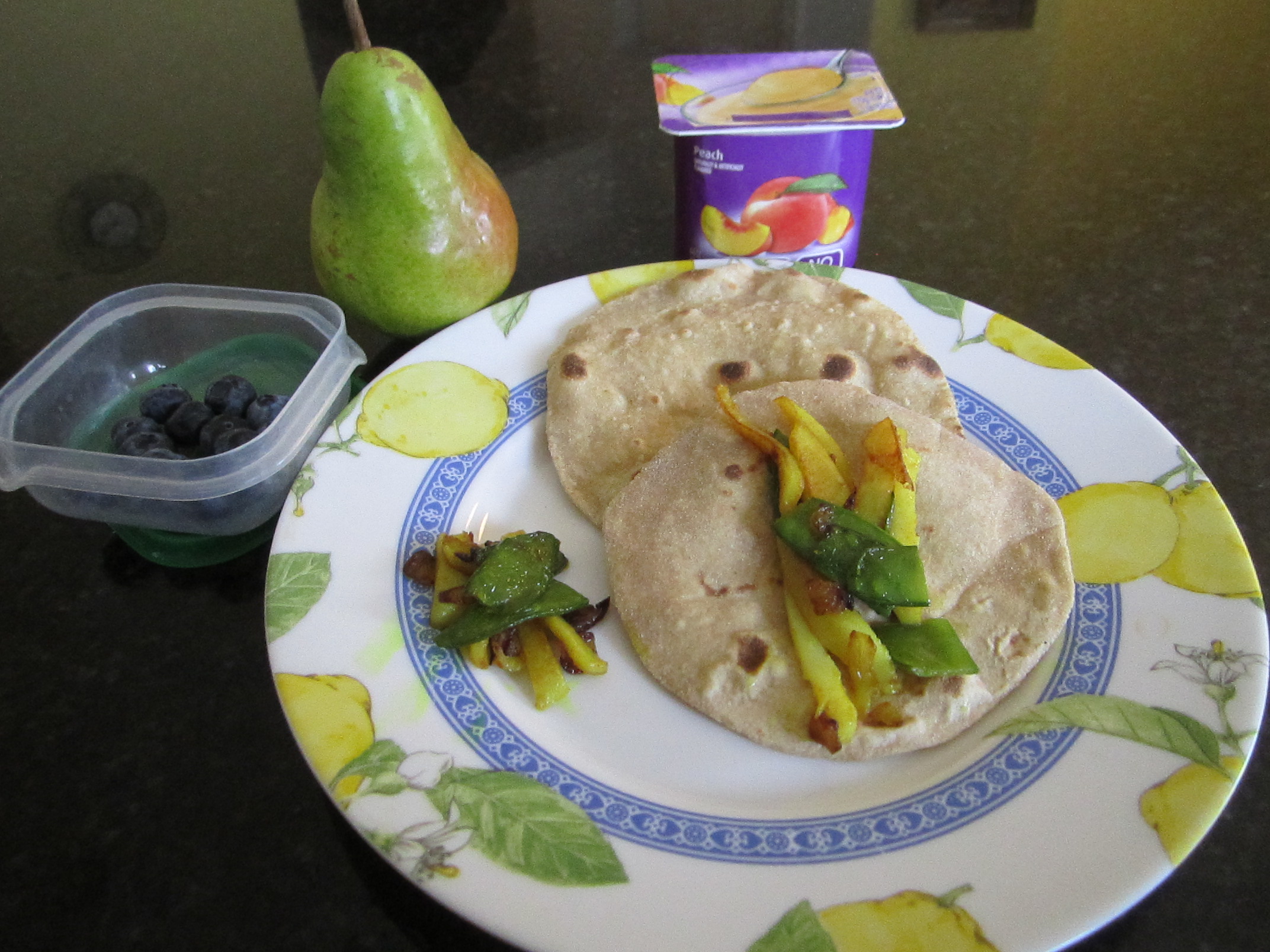
The theme for bloggers donating posts is lunch. In keeping with that, I thought I would share my story of packing lunch for my kids. When Kid 1 started school, we agreed that she would buy lunch on one day, usually on Friday when pizza was offered and the rest of the days I would pack lunch for her. Mindful of children with nut allergies, the school prohibits peanut butter but other than that we experimented and tried out every kind of sandwich filling we could imagine and my child was happy to eat sandwiches everyday. I would listen to the complaints of other parents about packing lunch for a picky eater and be thankful for my blessings. Then came Kid2 and my world turned upside down: the lunchbox would come back almost just as it was sent out, sandwiches were boring, pasta was “too cold”, chicken smelled “funny”, I just could not get it right.

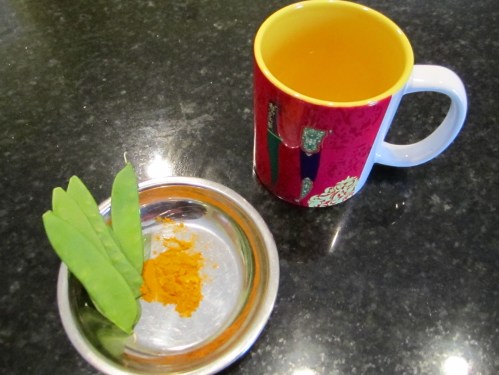
Desperately searching for a solution, I fell back on the lunches of my childhood, the soft rotis , the delicious stuffing that my mother would roll up in them; and I decided to try and replicate it. Since Kid 2 is constantly vowing to become a vegetarian “from my next meal”, I have to chosen a simple and easy vegetable dish that makes the lunch nutritious and yummy.
IMG_0008

Easy Indian Vegetable Medley

Ingredients:

1 onion

1 potato

1 carrot

A few green beans/flat beans

2 or 3 stalks of cauliflower/broccoli

1 green chilli

1/2 tsp cumin seeds

1/2 tsp turmeric powder

Salt to taste

Method:

Slice the onion finely. The vegetables should be chopped fine, length wise. This ensures that all the ingredients are roughly the same size and will cook at the same rate so none are left too raw or overcooked. Any combination of vegetables will work but I have included our favorites, sometimes I have only two or three of these to hand but the recipe works just as well.

Heat oil in a pan. Keeping the heat at medium, add the cumin seeds (these are available at all Indian grocery stores and many regular grocery stores as well. if you do not have them, you can still go ahead and make this). When the seeds are toasted, they turn a darker shade and it is time to add the onions. Let them cook till they are soft and then add the vegetables. Toss all the ingredients together and let this cook for 2-3 minutes, stirring occasionally. Then add the turmeric (availability same as that of cumin) and salt ,and mix well. Cover and let it cook for about 5-7 minutes. Take off the lid and check to see if vegetables are tender but not mushy. At this stage  you can add the green chilli, sliced in half, for a little bite if you like. Increase the heat and cook for a minute so the vegetables are crisp and bright.

I usually roll this up in a roti  made at home with whole wheat flour. This can also be purchased at the Indian store or substituted with tortillas. Since the school day is long, this is supplemented with fruits and yogurt. Often, this is what I have for lunch as well.

IMG_0012

The campaign runs through this week and even donating my weekly coffee budget would make a difference,  and I certainly intend to do so.We have many choices for lunch, I intend to share this good fortune with those who have none and  make a donation here.Please do consider it as well.


Farmers’ Markets Dwindling in Paris

bag


Yesterday I discovered that Italians are no longer cooking at home like they used to and today I learn that those wonderful farmers markets of Paris are disappearing! Truly, the world of food is not what it used to be.Again, why? what has changed and led people away from the fresh produce, breads and cheese of the neighborhood market to the all in one hypermarche? Perhaps it is convenience, we are all pressed for time these days, or perhaps tastes have changed….

Have you been traveling or relocated and found the local food culture to be different from what is generally known about that country/region? If so, I would love to hear from you!


Do You Microwave Your Pasta?

pasta


No need to feel guilty, though, because even the Italians are doing it now! Yes, the land of  fresh tomatoes, cheese and olive oil is succumbing to the allure of processed food, sodas and even MacDonald’s . All this I discovered on reading this excerpt from a new book “The Lost Art of Feeding Kids: What Italy Taught Me About Why Children Need Real Food”  by Jeannie Marshall.

Apparently, only old ladies go shopping for fresh groceries, most adults do not cook  and children are drinking Coke with their pizza. All this was interesting but what I was dying to know was: why? why has the Italian lifestyle become so much like the American one? Does the book provide an answer? No clue but if you read it, please let us know!

Image Courtesy: Apolonia, Freedigitalphotos.net

Water and Technology in Farming

irri

This post grew from a discussion on Twitter about the state of Indian agriculture. Why, it was asked , would young people, choose to work on farms when they could get less demanding and higher paying jobs in malls and call centers in the cities? Perhaps, technical innovations that would increase productivity and income might make farming a better career choice? Then it was noted that Indian agriculture continues to remain dependent on the monsoons for water and new technology might provide some solutions.   By a curious synchronicity I came across this article on Peruvian farmers using modern technology and older knowledge to deal with climate change that makes rainfall erratic.

The indigenous communities were struggling with new conditions which meant that rainfall came in short, intense bursts and the soil does not retain enough water for pastures or subsistence crops. The weather that they collaborated to collect with the aid of technology painted a bleak picture of an uncertain future for rural communities.The solution: to build water reservoirs similar to those used by the Incas.

What struck me most in this piece is the development and sharing of this knowledge by the community members themselves. Also, the recognition that this program is only a part of the solution. Climate change is going to require a huge and varied effort from all of us, from the farmer in rural Peru to those who are reading and sharing these stories in urban settings. There is no magic wand, no perfect solution, we must try all that we know (including genetic modification) without prejudice.

As I was writing this, I remembered reading about an app that alerts the farmer to when and how much water is needed. I had forgotten to bookmark the source so I decided to search for it and here is the first page of search results!  I had no idea that there was such an array of options available at the swipe of a screen! How accessible and relevant are these for the farmers in Peru or India? That will be explored in another post: do share your experiences and stories in the comments , it would be great to include those as well.

(Image Courtesy of FreeDigitalPhotos.net)


Non-GMO Cheerios: Something to Cheer About?

28047578

The news that General Mills is going to eliminate genetically modified elements from their line of Original Cheerios was greeted with cheers by many. If true, it would represent a big change in the way the cereal is produced. But how big is this change, I wondered.  Reading closely we find that the main ingredient, oats, were not GM anyway, it is the corn starch and sugar that are being sourced differently and this will only happen for the Original line not for others like Honey Nut, Fruity Cheerios , Apple Cinnamon etc. It is, then, only a small tweak in only one cereal, right. Wait, there is more: on her blog, the Farmer’s Daughter  USA quotes Margaret Smith, Professor of Plant Breeding at Cornell University.

“In reality, Cheerios isn’t changing at all. Margaret Smith, professor of plant breeding at Cornell says:

Corn starch and sugar are highly refined products, so they contain no DNA (which is what is introduced into a genetically engineered organism) and no protein (which is what the new DNA would produce in a genetically engineered organism). Because of that, corn starch and sugar from a genetically engineered corn variety are nutritionally and chemically identical to corn starch or sugar from a non-genetically engineered variety.

It is the exact same cereal.”

The statement from the company seems to indicate that the corn and sugar General Mills uses in future will be conventional, non-GMO (there is no mention of use of organic crops). The main reason for using GM corn is to prevent crop loss to pests,  not world domination ,as so much of anti-GMO propaganda insists. So, how are the pests going to be dealt with? Would this mean increased pesticide use to prevent crop losses? Everyone agrees this is not such a good thing: for the farmers who have to handle and apply the stuff, for the consumers or for the planet. The use of non-GMO crops involves a real cost in terms of crop loss which in turn would impact prices of these crops and the quantities produced, more here.  For example, if in a given year,  x hectares of corn was planted with the expectation of a yield of  y tonnes, and the yield is lower due to crop loss to pests; global demand for corn stays ahead of global supply, next year the farmers might respond by growing x+some hectares by cutting down forests. That is not a great outcome. Would it be better to switch to organic corn and sugar? There are doubts about organic cultivation bringing in the required yields . Besides, organic farming also uses pesticides, just different ones from those in conventional farms.

So far, none of this is positive. And the question remains, why this decision now? What does the producer get out of this?  Well, the company can, for example, put on a big label on its package saying “No GMOs Used” (or something to that effect). This highlights exactly my misgivings with the labeling issue. Basically  a label can obscure as much as it reveals. Consumers, overwhelmed with all the fear mongering on the GMO issue might be persuaded to buy more of what they think is “safer” for their families. This means more sales and more profits, good news for the company.While General Mills has a big chunk of the market, its share has slipped in 2013 (by a tiny bit) and this would be a good time to bump up the numbers.

Just as the insistence on a tortuous and long drawn out approval process for GMO crops tips the balance in favor of big corporations; the clamor for labeling can also have unintended consequences. It will make a difference , yes, but to the big  producers and not to the consumer. Not much to cheer about, after all.

The Whole Foods-Chobani Episode: The Whole Truth?

greek


When Whole Foods recently decided to discontinue carrying Chobani Greek yogurt, the first news reports attributed this to Whole Foods’ decision to eliminate GM products from their stores. But now, another reason has emerged. Whole Foods, it is argued, wants to reap larger profits from the current Greek yogurt frenzy by introducing their own version of it; a “private label”, apparently, is the term although I always thought of it simply as “store brand” ,the plain cousin of the glamorous big brands but just as good and a boon for a mother on a budget! So the issue of GMO/Organic was simply not relevant here.

This comes just after another GMO vs Organic issue which grabbed the headlines: “Organic Milk Better for You” the media announced quoting a study which found higher levels of omega 3 in certain types of milk. Read a little deeper and you will find that the real cause of higher levels of fat in the milk was determined by the what the cows ate. Grass fed cows produced milk with higher levels of  omega 3. Is this true for all organic milk? Well, it depends. It turns out that cows can be fed grass for only 4 months a year and still qualify for the organic label. Are they living on fresh air the rest of the year? No they are eating feed which would mostly consist of corn. So technically, it seems, you could have a cow feed partly on GMO corn  and partly on pasture and that cow would have healthier levels of omega 3 because it was grass fed, organic feed is not the determinant here.  So next time you think about paying the steep price of organic milk because you think it will be better for your children, remember that in this case “from grass fed cows” would really be the label you need to see.

This kind of smudging of facts is not uncommon in the charged discussions on GMO foods, but then I found something that went beyond mere dancing with words. Consider this label:

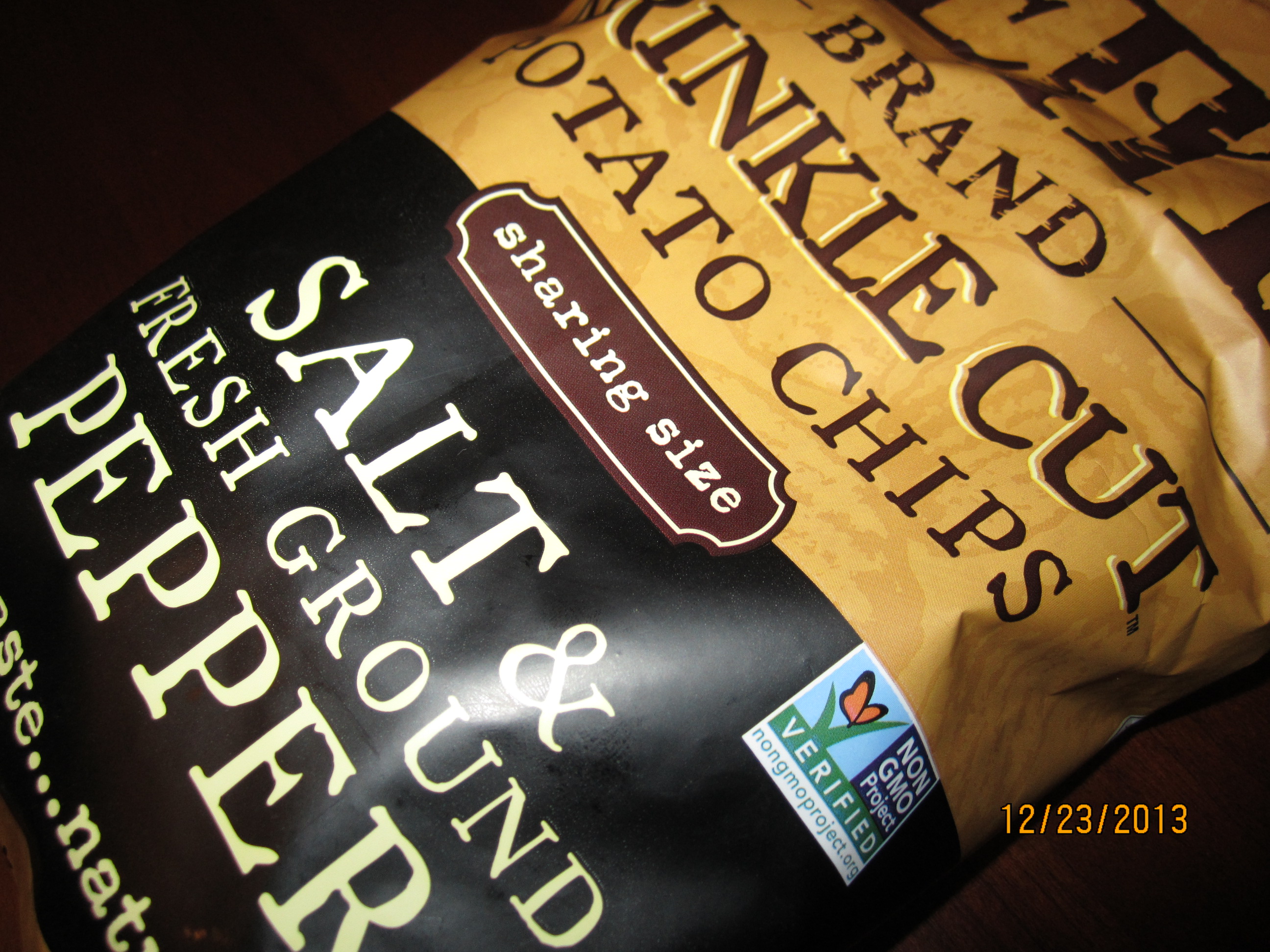
IMG_0005The label says “NON GMO Project VERIFIED” . So, what is n0n-GMO here? The potatoes? salt? pepper? Genetically modified potatoes are not a part of the food supply of any country on the planet. It is not possible for me to enjoy a genetically modified potato chip even if I was craving it, so why this label?  Perhaps in the hope that the consumer who hears a lot of fear mongering on this issue and, without actually checking on the particular details in the midst of a grocery run, will make a decision to buy this product instead of another.

From all the studies and research that I have followed so far, there appear to be no safety issues with GMO foods so there seems no reason to slap on what is tantamount to a warning label. But faced with the argument that no label indicates something is being hidden, I would advocate labeling because this is only one variable influencing the consumer’s decision to buy; and price is, I think, the variable that carries the greatest weight in that decision making process. But the real troubling issue here is how labeling can be subverted so that the concerns that are supposedly being met here (health, food safety etc) are simply a facade for the drive toward higher profits.

Farming in a New Land: Syrian refugees in Lebanon

farm1

Sometime ago I wrote about the drought in Syria that had been an underlying cause of the unrest there. Here is some news now on the farmers who are trying to make a new life in Lebanon. While some of them used to come in as temporary workers in the past and are now moving for good, some people are fleeing the violence and taking up farming jobs to support their families. Life has also changed for the farmer in Lebanon who finds it difficult to market his produce but the stories of the woman who has planted a few flowers because she misses her garden back home; or the girl who dreamed of being a doctor one day are poignant.

Just Label It!


cherry

I watched the GMO labeling debate closely in California and cheered when the proposition was defeated there. But when I read the arguments from the pro-labeling side,(based mostly on misinformation and unsubstantiated fears) I began to think that blocking labeling is perhaps not the best strategy. GMO foods, it has been proven, again and again, are  safe for human consumption. The pro-label lobby has therefore, framed the debate in terms of the “consumer’s right to know what is in their food”. It is hard to make the case that the consumer should not know/does not need to know what is in their food and so, blocking labeling makes it seem like the producers of food containing GM ingredients are hiding something. One would like to ask the question: how would knowing this be useful to the consumer anyway? If they do not want to purchase GMO products, there is already a label for them: it says “organic” or that fascinating mystery term, “natural” which many seem to rely on.

It is important to remember that this debate is being played out in parts of the world that have the luxury to debate about food. In other areas, where people are going hungry every day, children are malnourished and suffering from dietary deficiencies, food on the table is a survival issue. Biotechnology offers a way to combat global hunger. By  blocking labeling and letting the “there is something to hide” misinformation gain ground, we are denying choices precisely to those who are most vulnerable. If we continue to block labeling, the ultimate aim of the anti-GM lobby; to take biotechnology out of the options forever, would be achieved and this would be a disaster in the struggle to deal with hunger and malnutrition.

Instead, imagine a situation where the labeling issue is actively owned by those seeking to make sure the benefits of GM foods actually reach the public. Companies need to proactively steer the labeling issue in a positive direction: uniform labels for the whole country so that the same chaotic battles do not have to be fought over and over again in each state, providing more opportunities for spreading misinformation. The actual words on the label are crucial and that should not be dictated by the naysayers. Ideally, I would propose :”This product contains GM ingredients which have been more rigorously tested than most products in your grocery store. They are produced using less pesticides and so are better for the farmers who grow them and our planet. They are also fortified with Vitamin A (for example) which will prevent blindness and death in millions of children.” But that is a dream and in the real world, companies will have to work hard to merely ensure that negativity is minimized.

In purely economic terms, there is a far bigger market out there as measured by currently undernourished/malnourished people than the few who might switch from buying products post labeling. And, most important to remember, the one piece of information on the label which seals the deal for a consumer on a budget is the price.If there is an initial cost increase involved, companies need to refrain from passing that on immediately to the consumer. Instead, let them read the label, see the price, compare it to the high priced organic option and make their decision.

You can read more on both sides of this here and here.