
Farming Friday Series: How a Farmer defines Himself and his Farm
When I started this blog, it was a step into a journey as much of writing and sharing as of learning. And one of the first things I learnt is that,as an urban consumer, I had only the faintest notion of how our food is grown and my experience of food is mainly from the fork’s perspective rather than the field so to stay true to my goal of taking a thoughtful look at the journey of food from the field to the fork, I would like to start a series aimed at improving this aspect. So, every Friday I will share a post from the many interesting and lively farmers blogs that I have had the pleasure to discover.
First up in the Friday Farming series: hear from a farmer who makes the point that it is not the size of the farm alone that makes it a “family farm” or a “factory farm” but also who works there.
Of Organic Eggs and Antibiotics

Reading this piece on organic eggs today I was reminded of the famous painting of a pipe by Rene Magritte, entitled “Ceci n’est pas une pipe” or “This is not a pipe”, it is merely the representation of a pipe. Or, nothing is what it seems. In the piece, it is revealed that organic eggs are treated with an antibiotic, gentimicin. This is actually used to seal in the tiny hole made to vaccinate the egg against Marek’s disease. This is done on the first day of the life cycle of the egg. But to be classified as “organic”, the egg only needs to be free of antibiotics from the second day of life so this egg will go on to hatch and the eggs from that chicken will come to our tables. Is this still an “organic egg”? (The organic eggs sold for consumption are, however, not treated with gentimicin). How does this make us feel about the categorization of these eggs as organic?
For me, it is reminiscent of the bump down to earth I felt when I discovered that the organic strawberries that my toddlers loved, and that I paid a hefty premium for, actually started life in the nursery doused with methyl bromide, soil sterilizer and pesticide. At the time of this report, two years ago, there were no organic nurseries in California which provide fruit and seedlings to consumers all over the world. Yet some would opt for the organic produce from those very seedlings over conventional produce and pay more for it. Are they really getting “organic strawberries”?
The intention here is not to devalue organic methods but to underline the fact that debates on the food system are often disconnected from ground realities. Seedlings, eggs etc will be prone to pests and diseases and we have to find a way to protect what we grow. Insistence on some arbitrary “natural” , or “local” standard ignores the fact that pests do exist in nature and crops have to be protected from them. This insistence on unreal qualities is then exploited by retailers who will use terms like “natural”, “local” or “sustainable” which actually have no backing or meaning to them, on labels and make a profit by selling a higher quantity.
As the labeling war wages on in different states, it might be a good idea to pause for a moment and reflect on what it would achieve. If current labels mask loopholes, would future labels be of any value? More importantly, is it going to be worth the time, money and resources that are currently being directed into this contest? There are much bigger problems we need to attend to: too many people going hungry , too much food being wasted, sources of water running alarmingly low levels, unpredictable climate posing challenges to our current ways of growing food; all of which need our energy more than semantics.
Posted in Farm Technology, Food Safety, Green, Living
Tagged Farming Technology, food security, Green
‘Frostbite on their teats’ and other cold weather farming issues
Heard a lot of complaints about the polar vortex? At least you are not a farmer who gets no snow days….
Posted in Uncategorized
10 Ag-Related Items to Watch in 2014

By John G. Dillard, as published on his AgWeb.com Blog – Ag in the Courtroom
With 2013 nearly in the books and the holiday season nearly behind us, its time to prepare for the challenges that face us in the coming year. While I am no expert on forecasting long-range weather patterns, commodity market fluctuations, or predicting the future of the Kardashian family, I do feel adequately qualified to indulge in a few predictions regarding what will be hot topics in the agricultural policy realm in the coming year. Accordingly, I, like most writers with access to an audience, have prepared a top 10 list of things to watch in agriculture in 2014.
1. The 2012 2013 2014 Farm Bill
Farm Bills are getting harder and harder to come by these days. The 2012 effort to pass a Farm Bill failed. Congress punted by granting a one-year extension. The…
View original post 1,555 more words
Posted in Uncategorized
Non-GMO Cheerios: Something to Cheer About?
The news that General Mills is going to eliminate genetically modified elements from their line of Original Cheerios was greeted with cheers by many. If true, it would represent a big change in the way the cereal is produced. But how big is this change, I wondered. Reading closely we find that the main ingredient, oats, were not GM anyway, it is the corn starch and sugar that are being sourced differently and this will only happen for the Original line not for others like Honey Nut, Fruity Cheerios , Apple Cinnamon etc. It is, then, only a small tweak in only one cereal, right. Wait, there is more: on her blog, the Farmer’s Daughter USA quotes Margaret Smith, Professor of Plant Breeding at Cornell University.
“In reality, Cheerios isn’t changing at all. Margaret Smith, professor of plant breeding at Cornell says:
Corn starch and sugar are highly refined products, so they contain no DNA (which is what is introduced into a genetically engineered organism) and no protein (which is what the new DNA would produce in a genetically engineered organism). Because of that, corn starch and sugar from a genetically engineered corn variety are nutritionally and chemically identical to corn starch or sugar from a non-genetically engineered variety.
It is the exact same cereal.”
The statement from the company seems to indicate that the corn and sugar General Mills uses in future will be conventional, non-GMO (there is no mention of use of organic crops). The main reason for using GM corn is to prevent crop loss to pests, not world domination ,as so much of anti-GMO propaganda insists. So, how are the pests going to be dealt with? Would this mean increased pesticide use to prevent crop losses? Everyone agrees this is not such a good thing: for the farmers who have to handle and apply the stuff, for the consumers or for the planet. The use of non-GMO crops involves a real cost in terms of crop loss which in turn would impact prices of these crops and the quantities produced, more here. For example, if in a given year, x hectares of corn was planted with the expectation of a yield of y tonnes, and the yield is lower due to crop loss to pests; global demand for corn stays ahead of global supply, next year the farmers might respond by growing x+some hectares by cutting down forests. That is not a great outcome. Would it be better to switch to organic corn and sugar? There are doubts about organic cultivation bringing in the required yields . Besides, organic farming also uses pesticides, just different ones from those in conventional farms.
So far, none of this is positive. And the question remains, why this decision now? What does the producer get out of this? Well, the company can, for example, put on a big label on its package saying “No GMOs Used” (or something to that effect). This highlights exactly my misgivings with the labeling issue. Basically a label can obscure as much as it reveals. Consumers, overwhelmed with all the fear mongering on the GMO issue might be persuaded to buy more of what they think is “safer” for their families. This means more sales and more profits, good news for the company.While General Mills has a big chunk of the market, its share has slipped in 2013 (by a tiny bit) and this would be a good time to bump up the numbers.
Just as the insistence on a tortuous and long drawn out approval process for GMO crops tips the balance in favor of big corporations; the clamor for labeling can also have unintended consequences. It will make a difference , yes, but to the big producers and not to the consumer. Not much to cheer about, after all.
Posted in Farm Technology, Food Choices, Food Policy, Green, Price Rise
Tagged Farming Technology, food decisions, food policy, Green, Living, Price Rise
Dentist: Chocolate and cola are better than kale juice
As we make healthy resolutions for the new year, perhaps the first one to be to apply common sense when making decisions and trust those who have specialized knowledge in that field.
Posted in Uncategorized
Looking Ahead: Food Choices
There is a certain sense of deja vu as we look ahead to 2014. For one thing we are still talking about a Farm Bill that may or not happen, just as we were last year! For some insight into why we are stuck here, this is a revealing piece. Also, some information on issues under discussion in the Bill is here. And no, we are not going to fall off the dairy cliff!
Some of the issues I want to learn more about this year are land rights, food sovereignty and how climate challenges in the food system might be met. I look forward to sharing all that with you here and hearing your opinions as well.
Wishing you all a fulfilling year ahead!
Posted in Uncategorized
Small blog, Big Hopes! 2013 in review
The WordPress.com stats helper monkeys prepared a 2013 annual report for this blog.

Here’s an excerpt:
A San Francisco cable car holds 60 people. This blog was viewed about 2,300 times in 2013. If it were a cable car, it would take about 38 trips to carry that many people.
Posted in Uncategorized
The Whole Foods-Chobani Episode: The Whole Truth?

When Whole Foods recently decided to discontinue carrying Chobani Greek yogurt, the first news reports attributed this to Whole Foods’ decision to eliminate GM products from their stores. But now, another reason has emerged. Whole Foods, it is argued, wants to reap larger profits from the current Greek yogurt frenzy by introducing their own version of it; a “private label”, apparently, is the term although I always thought of it simply as “store brand” ,the plain cousin of the glamorous big brands but just as good and a boon for a mother on a budget! So the issue of GMO/Organic was simply not relevant here.
This comes just after another GMO vs Organic issue which grabbed the headlines: “Organic Milk Better for You” the media announced quoting a study which found higher levels of omega 3 in certain types of milk. Read a little deeper and you will find that the real cause of higher levels of fat in the milk was determined by the what the cows ate. Grass fed cows produced milk with higher levels of omega 3. Is this true for all organic milk? Well, it depends. It turns out that cows can be fed grass for only 4 months a year and still qualify for the organic label. Are they living on fresh air the rest of the year? No they are eating feed which would mostly consist of corn. So technically, it seems, you could have a cow feed partly on GMO corn and partly on pasture and that cow would have healthier levels of omega 3 because it was grass fed, organic feed is not the determinant here. So next time you think about paying the steep price of organic milk because you think it will be better for your children, remember that in this case “from grass fed cows” would really be the label you need to see.
This kind of smudging of facts is not uncommon in the charged discussions on GMO foods, but then I found something that went beyond mere dancing with words. Consider this label:
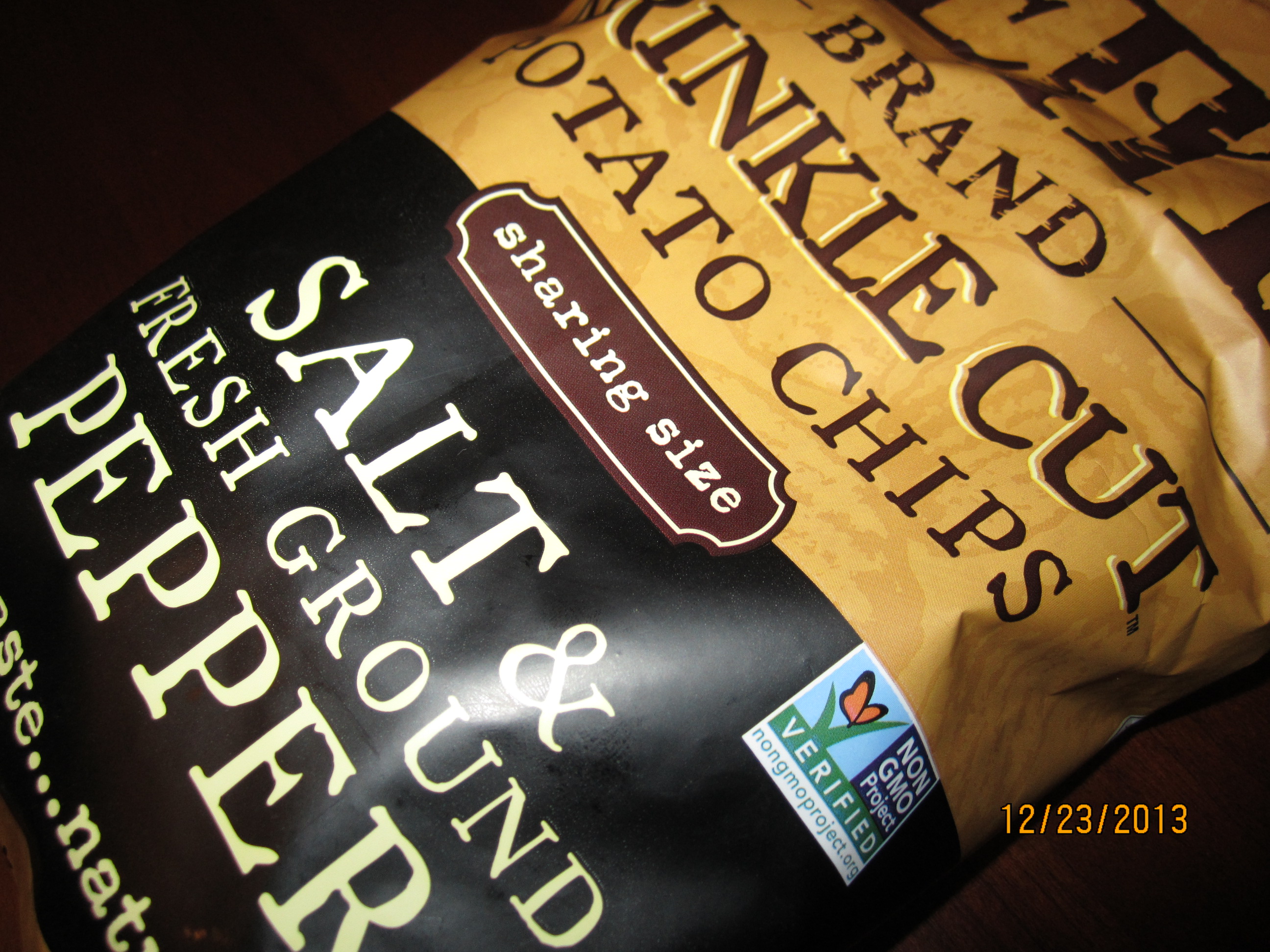 The label says “NON GMO Project VERIFIED” . So, what is n0n-GMO here? The potatoes? salt? pepper? Genetically modified potatoes are not a part of the food supply of any country on the planet. It is not possible for me to enjoy a genetically modified potato chip even if I was craving it, so why this label? Perhaps in the hope that the consumer who hears a lot of fear mongering on this issue and, without actually checking on the particular details in the midst of a grocery run, will make a decision to buy this product instead of another.
From all the studies and research that I have followed so far, there appear to be no safety issues with GMO foods so there seems no reason to slap on what is tantamount to a warning label. But faced with the argument that no label indicates something is being hidden, I would advocate labeling because this is only one variable influencing the consumer’s decision to buy; and price is, I think, the variable that carries the greatest weight in that decision making process. But the real troubling issue here is how labeling can be subverted so that the concerns that are supposedly being met here (health, food safety etc) are simply a facade for the drive toward higher profits.
Posted in Farm Technology, Food Choices, Food Safety, Living, Nutrition
Tagged Farming Technology, food decisions, Genetically Modified Organisms, Living
 Thought + Food