Category Archives: Uncategorized

India’s 2016 Budget: Good for Farmers?

ID-100331111

India’s budget for the new financial year was announced yesterday. Earlier, the prime minister had described it as “pro-village, pro-farmer and pro-poor”. The announced objective of doubling farm income in five years is difficult to evaluate at this point but the additional support for the MNREGA scheme is expected to provide a boost to rural incomes.

The Economic Survey, identifying the roots of economic distress in the farm sector, noted: “The declining growth in agriculture owing to two consecutive drought years, and with decline in production and area sown of major crops, agriculture sector needs a transformation to ensure sustainable livelihoods for the farmers and food security for the population. The transformation in agriculture has to be steered by raising productivity in agriculture, by investing in efficient irrigation technologies, and efficient use of all inputs.”

The increasing scarcity of water, further exacerbated by climate change underscores the need for expansion of irrigation facilities and the allocation for this purpose may not be enough. Budgets in the past have also had the goal of improving irrigation but little progress has been made so more effort here would have been welcome.

While investment in irrigation is essential, the Survey also identified other stressors that need to be attended to: “agriculture requires a new paradigm with the following components: increasing productivity by getting “more from less” especially in relation to water via micro irrigation; prioritizing the cultivation of less water-intensive crops, especially pulses and oil-seeds, supported by a favorable Minimum Support Price (MSP) regime that incorporates the full social benefits of producing such crops .” Long term sustainable growth in agriculture needs more investment in research and extension so that new varieties that can withstand the changing growing conditions due to climate disruption are developed and farmers are informed about how to use these and other inputs effectively. How the government plans to achieve this is not clear.

The push for rural electrification and roads and the soil health card initiative are welcome steps forward. The push to bring more land under organic farming is a little confusing; for the vast number of rural poor struggling to eke out a living on poor quality soil without access to improved seeds or effective fertilizers, they are by default organic farmers. It is crucial that Indian agriculture avoid getting mired in the labeling game and focus on blending good farm practices that have been developed by our farmers over centuries and advances in agricultural biotechnology which have the potential to support drought and saline resistance, bring greater yields through pest resistance and via biofortification enable us to tackle widespread malnutriton and stunting.

On the whole though, the focus on agriculture is positive measure which will benefit the Indian economy as a whole. To sum up , from the Economic Survey again: “Few scientists think of agriculture as the chief, or the model science. Many indeed do not consider it a science at all. Yet it was the first science – the mother of all sciences; it remains the science which makes human life possible; and it may be that, before the century is over, the success or failure of science as a whole will be judged by the success or failure of agriculture.” –T.W. Schultz

With cautious optimism, it can be said this budget takes tentative initiatives in that direction of sustained progress.

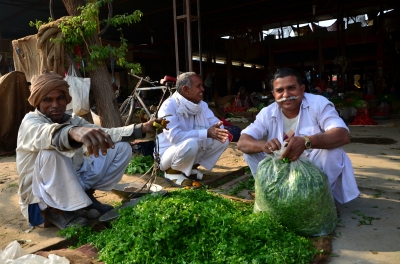
(Image Courtesy: “Jodhpur, India, January 1, Unidentified Man Selling..” by Sira Anamwong, freedigitalphotos.net)

#Farming Friday 46: European Farmer Reflects on GMOs

ID-100329984

In which a farmer from the Netherlands comes to Iowa, meets farmers from all over the world: from large farms and small, some prosperous, some struggling; and discovers that there is more to the GMO narrative than the usual noise that fills the media and a new discourse is needed in Europe.

This is the first time I have been able to feature the views of a farmer from Europe in this series. I am particularly delighted about this because one of the most common comments thrown out in social media discussion is “Look at Europe”. Here we get to read the story of insights that emerge when Europe looks at the world. This is how the food system discussion should be, reflecting all or as many voices as possible, starting with those who grow the food.


(Image Courtesy: “Old Windmill in Keukenhof, Lisse” by Sira Anamwong, freedigitalphotos.net)
Snow Day On A Dairy Farm

#Farming Friday 45: A peek into what a snowy day means for a farmer.

farmerbright's avatarFarmer Bright

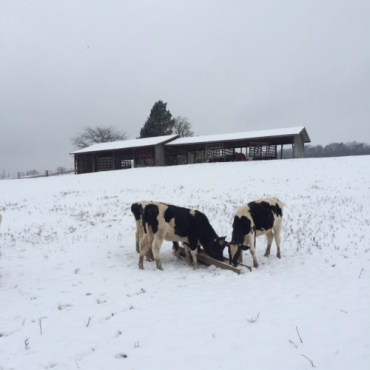
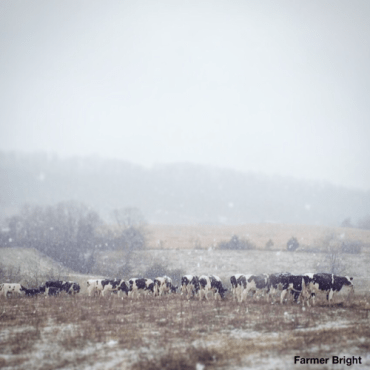
While everyone else is rejoicing the snow day that’s happening here, for us it simply means that life will be more difficult. Every day is work on a dairy farm, but when snow arrives with cold temperatures it can make even the easiest chore hard.The local television news crews may remind viewers to care for their dogs and cats, but a few hundred hungry bovines is a different challenge altogether.

Food and water are not necessities reserved for people. Our young calves stay inside barns and providing extra hay and water for them isn’t too tough. The older heifers that are in the elements require more. They need more to eat because that will provide them with the calories they need to stay warm.

snow cows Heifers Eating Hay in the Snow
Heifers Heifers Eating Feed

Water, water, everywhere,

Nor any drop to drink.

-The Rime of The Ancient Mariner, -Coleridge

Snow, sleet…

View original post 227 more words

Wordless Wednesday: A Winter Sunset on the Farm

Beautiful view from the farm!

Year End Food Reads and Possibilities for 2016

ID-100338573

On the last day of the year, some insights on the year in agriculture in the US, research on farming and rural communitiesand a look at the growing place of agricultural biotechnology in the food system.

As a planet, we all had a moment of hope as the Paris climate talks seemed to bring some possibility of action in the right direction but climate disruption is already impacting food production and food security in many communities. A plan to combat climate change must include a plan for food production and the understanding that conservation and agriculture are not separate and opposing goals. Rather, initiatives that focus on both are optimal.

While it is encouraging to see the efforts to reduce food waste on the consumption side, much remains to be done on reducing postharvest losses which are particularly significant in developing economies: great reads on that here.

My wish for 2016: less shouting from entrenched positions and more efforts at working together to nurture a food system that can combat hunger, malnutrition and climate change. Inspired by a farmer’s call for unity.

Thank you for stopping by to read this year! See you in 2016!

(Image Courtesy: Serge Bertasius Photography, freedigitalphotos.net)

#Farming Friday 44: Thankful for Sweet Potatoes!

ID-100233755

Our favorite way to make sweet potatoes is  “baked fries: which basically means cutting them up like fries and then baking them with some salt, pepper and olive oil. That is just one of the many ways sweet potatoes will show up on tables throughout the country tomorrow. The sweet potato has a long history in the South but seems to be enjoying popularity everywhere right now because it is delicious and good for you. But getting the sweet potatoes out of the ground and on their way to a store involves a great deal of work: The potatoes have to be sorted and collected in buckets and when full (and weighing about 30 pounds) , they have to be loaded into trucks, the entire process being repeated between 400 to 500 times a day.

The story of those who pick them is rarely heard but in this piece, the reality of long days of back breaking labor is sweetened by the narrative of two pickers who met while picking peppers, are now married with a baby son, who move from sweet potato fields to tobacco, building a life for their family and delicious moments for us. We are thankful that our plates are full because of farmers and farm workers like them.

And bonus fun fact: did you know that sweet potato is a natural GMO?!

(Image Courtesy: “Sweet Potato on the White Background” by Sommai, freedigitalphotos.net)

FDA denies GMO labeling petition from CFS

This is an excellent summary of the recent FDA response to a labeling petition from the Center for Food Safety.

James Cooper's avatarFood Science Institute

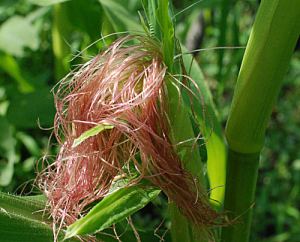
corn silk Corn silk

Andrew Kimbrell and his Center for Food Safety  filed a petition with the FDA arguing that all genetically engineered foods should be labeled. The FDA denied his petition last Friday in a 35 page ruling citing both science and existing law.

The petition was co-sponsored by Amy’s Kitchen, Annie’s Homegrown, Beyond Pesticides, the Center for Environmental Health, Consumer Reports (who should be ashamed of themselves), CROPP Cooperative, the Environmental Working Group, Food and Water Watch, Horizon Organic, Midwest Organic and Sustainable Education Service, the National Cooperative Grocer’s Association, the National Family Farm Coalition, Northeast Organic Dairy Producer’s Alliance, Northeast Organic Farmers Association, the National Organic Coalition, the Organic Seed Alliance, the Organic Seed Growers and Trade Association, the Organic Trade Association, Organically Grown Company, the Rural Advancement Foundation International, Save New Mexico Seeds, and Stonyfield Farm. The pro-organic biases of the members of the above groups should…

View original post 1,272 more words

Do GMOs accumulate formaldehyde?

Great analysis of the “Formaldehyde on GMOs” claim, also a nice perspective on how such claims should be analyzed!

James Cooper's avatarFood Science Institute

edamame Soybeans or edamame

We recently came across this paper by V.A. Shiva Ayyadurai and P. Deonikar titled “Do GMOs Acuumulate Formadehyde and Disrupt Molecular Systems Equilibria? Systems Biology May Provide Answers.” We decided that checking the credibility of this paper might make an interesting tutorial in scientific skepticism. To start with, we are only dealing with the evidence presented by the paper, and not any public claims the author has since made.

So let’s take a look at this paper’s claims and pedigree and see how we can decide how seriously to take it. It’s worth undertaking this little exercise, because it seems to indicate the genetically modified plants (in this case soybeans) produce significant levels of formaldehyde, which is at some level toxic, and frankly this seems quite unlikely to have just been discovered now.

Let’s start with some simple questions.

  1. Where was the paper published? In

View original post 1,065 more words

#Farming Friday 43: Gardens of Hope

ID-100246817

Today’s story from Kyrgyzstan has roots that are common to many rural communities across the world: the young men of the household move to cities or even to other countries in search of better livelihoods and the women are working the farms and growing the food. Faced with raising 12 grand children, this Kyrgyz grandmother found hope and security in her peach gardenShe is supported by a program that provides seeds, equipment, training, and most importantly access to land.

(Image Courtesy: “Peach Blosson” by ahmet guler, freedigitalphotos.net)

Even kids who eat only organic can’t always escape exposure to pesticides

Source: Even kids who eat only organic can’t always escape exposure to pesticides