Category Archives: Living

Do You Microwave Your Pasta?

pasta


No need to feel guilty, though, because even the Italians are doing it now! Yes, the land of  fresh tomatoes, cheese and olive oil is succumbing to the allure of processed food, sodas and even MacDonald’s . All this I discovered on reading this excerpt from a new book “The Lost Art of Feeding Kids: What Italy Taught Me About Why Children Need Real Food”  by Jeannie Marshall.

Apparently, only old ladies go shopping for fresh groceries, most adults do not cook  and children are drinking Coke with their pizza. All this was interesting but what I was dying to know was: why? why has the Italian lifestyle become so much like the American one? Does the book provide an answer? No clue but if you read it, please let us know!

Image Courtesy: Apolonia, Freedigitalphotos.net

Of Organic Eggs and Antibiotics

soft-boiled-egg-in-a-white-cup-100150684

Reading this piece on organic eggs today I was  reminded of the famous painting of a pipe by Rene Magritte, entitled “Ceci n’est pas une pipe” or “This is not a pipe”, it is merely the representation of a pipe. Or, nothing is what it seems. In the piece, it is revealed that organic eggs are treated with an antibiotic, gentimicin. This is actually used to seal in the tiny hole made to vaccinate the egg against Marek’s disease. This is done on the first day of the life cycle of the egg. But to be classified as “organic”, the egg only needs to be free of antibiotics from the second day of life so this egg will go on to hatch and the eggs from that chicken will come to our tables. Is this still an “organic egg”?  (The organic eggs sold for consumption are, however, not treated with gentimicin). How does this make us feel about the categorization of these eggs as organic?

For me, it is reminiscent of the bump down to earth I felt when I discovered that the organic strawberries that my toddlers loved, and that I paid a hefty premium for, actually started life in the nursery doused with methyl bromide, soil sterilizer and pesticide.  At the time of this report, two years ago, there were no organic nurseries in California which provide fruit and seedlings to consumers all over the world. Yet some would opt for the organic produce from those very seedlings over conventional produce and pay more for it. Are they really getting “organic strawberries”?

The intention here is not to devalue organic methods but to underline the fact that debates on the food system are often disconnected from ground realities. Seedlings, eggs etc will be prone to pests and diseases and we have to find a way to protect what we grow. Insistence on some arbitrary “natural” , or “local” standard ignores the fact that pests do exist in nature and crops have to be protected from them. This insistence on unreal qualities is then exploited by retailers who will use terms like “natural”, “local” or “sustainable” which actually have no backing or meaning to them, on labels  and make a profit by selling a higher quantity.

As the labeling war wages on in different states, it might be a good idea to pause for a moment and reflect on what it would achieve. If current labels mask loopholes, would future labels be of any value? More importantly, is it going to be worth the time, money and resources that are currently being directed into this contest? There are much bigger problems we need to attend to: too many people going hungry , too much food being wasted, sources of water running alarmingly low levels, unpredictable climate posing challenges to our current ways of growing food; all of which  need our energy more than semantics.

The Whole Foods-Chobani Episode: The Whole Truth?

greek


When Whole Foods recently decided to discontinue carrying Chobani Greek yogurt, the first news reports attributed this to Whole Foods’ decision to eliminate GM products from their stores. But now, another reason has emerged. Whole Foods, it is argued, wants to reap larger profits from the current Greek yogurt frenzy by introducing their own version of it; a “private label”, apparently, is the term although I always thought of it simply as “store brand” ,the plain cousin of the glamorous big brands but just as good and a boon for a mother on a budget! So the issue of GMO/Organic was simply not relevant here.

This comes just after another GMO vs Organic issue which grabbed the headlines: “Organic Milk Better for You” the media announced quoting a study which found higher levels of omega 3 in certain types of milk. Read a little deeper and you will find that the real cause of higher levels of fat in the milk was determined by the what the cows ate. Grass fed cows produced milk with higher levels of  omega 3. Is this true for all organic milk? Well, it depends. It turns out that cows can be fed grass for only 4 months a year and still qualify for the organic label. Are they living on fresh air the rest of the year? No they are eating feed which would mostly consist of corn. So technically, it seems, you could have a cow feed partly on GMO corn  and partly on pasture and that cow would have healthier levels of omega 3 because it was grass fed, organic feed is not the determinant here.  So next time you think about paying the steep price of organic milk because you think it will be better for your children, remember that in this case “from grass fed cows” would really be the label you need to see.

This kind of smudging of facts is not uncommon in the charged discussions on GMO foods, but then I found something that went beyond mere dancing with words. Consider this label:

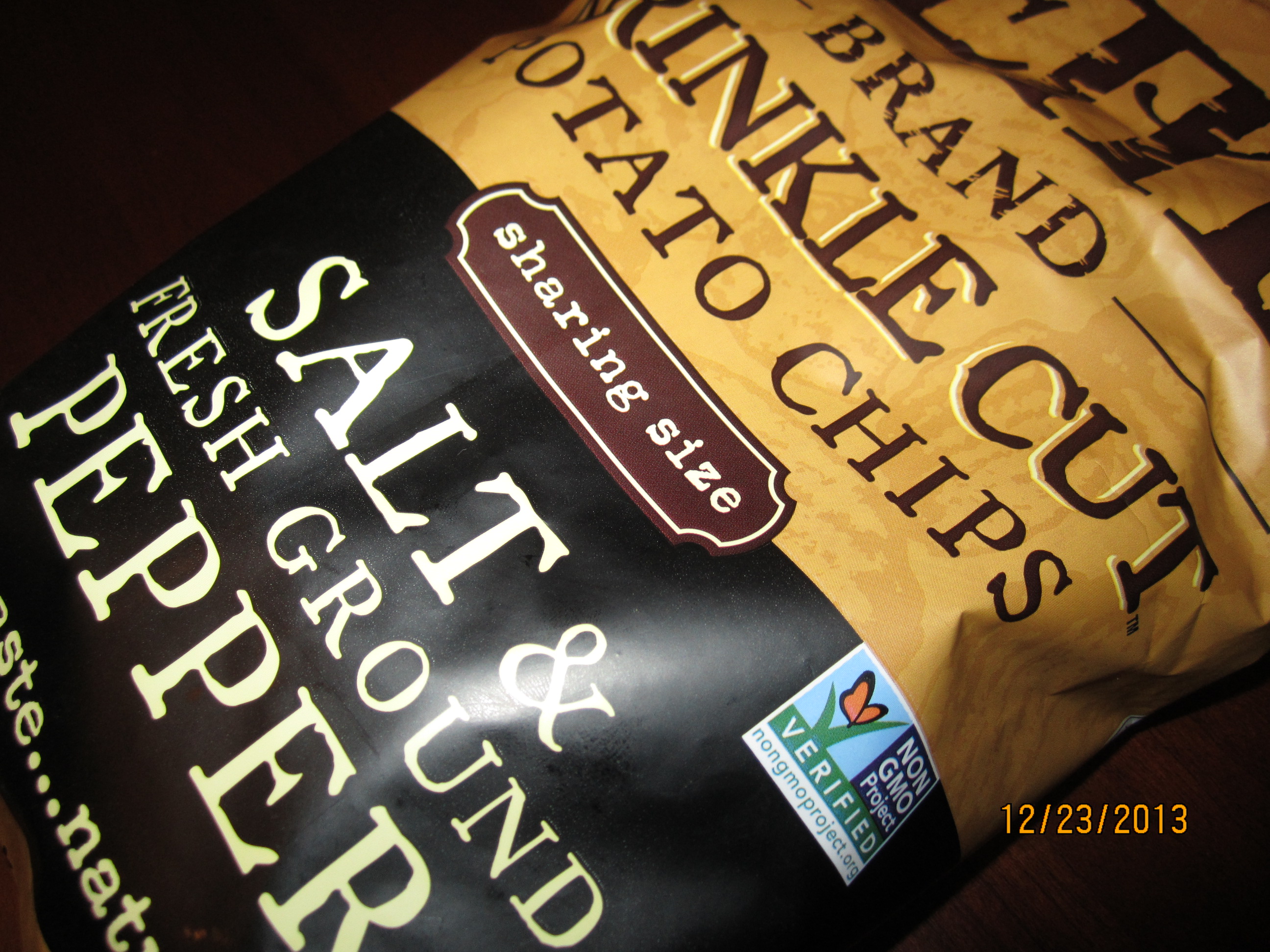
IMG_0005The label says “NON GMO Project VERIFIED” . So, what is n0n-GMO here? The potatoes? salt? pepper? Genetically modified potatoes are not a part of the food supply of any country on the planet. It is not possible for me to enjoy a genetically modified potato chip even if I was craving it, so why this label?  Perhaps in the hope that the consumer who hears a lot of fear mongering on this issue and, without actually checking on the particular details in the midst of a grocery run, will make a decision to buy this product instead of another.

From all the studies and research that I have followed so far, there appear to be no safety issues with GMO foods so there seems no reason to slap on what is tantamount to a warning label. But faced with the argument that no label indicates something is being hidden, I would advocate labeling because this is only one variable influencing the consumer’s decision to buy; and price is, I think, the variable that carries the greatest weight in that decision making process. But the real troubling issue here is how labeling can be subverted so that the concerns that are supposedly being met here (health, food safety etc) are simply a facade for the drive toward higher profits.

Farming in a New Land: Syrian refugees in Lebanon

farm1

Sometime ago I wrote about the drought in Syria that had been an underlying cause of the unrest there. Here is some news now on the farmers who are trying to make a new life in Lebanon. While some of them used to come in as temporary workers in the past and are now moving for good, some people are fleeing the violence and taking up farming jobs to support their families. Life has also changed for the farmer in Lebanon who finds it difficult to market his produce but the stories of the woman who has planted a few flowers because she misses her garden back home; or the girl who dreamed of being a doctor one day are poignant.

Just Label It!


cherry

I watched the GMO labeling debate closely in California and cheered when the proposition was defeated there. But when I read the arguments from the pro-labeling side,(based mostly on misinformation and unsubstantiated fears) I began to think that blocking labeling is perhaps not the best strategy. GMO foods, it has been proven, again and again, are  safe for human consumption. The pro-label lobby has therefore, framed the debate in terms of the “consumer’s right to know what is in their food”. It is hard to make the case that the consumer should not know/does not need to know what is in their food and so, blocking labeling makes it seem like the producers of food containing GM ingredients are hiding something. One would like to ask the question: how would knowing this be useful to the consumer anyway? If they do not want to purchase GMO products, there is already a label for them: it says “organic” or that fascinating mystery term, “natural” which many seem to rely on.

It is important to remember that this debate is being played out in parts of the world that have the luxury to debate about food. In other areas, where people are going hungry every day, children are malnourished and suffering from dietary deficiencies, food on the table is a survival issue. Biotechnology offers a way to combat global hunger. By  blocking labeling and letting the “there is something to hide” misinformation gain ground, we are denying choices precisely to those who are most vulnerable. If we continue to block labeling, the ultimate aim of the anti-GM lobby; to take biotechnology out of the options forever, would be achieved and this would be a disaster in the struggle to deal with hunger and malnutrition.

Instead, imagine a situation where the labeling issue is actively owned by those seeking to make sure the benefits of GM foods actually reach the public. Companies need to proactively steer the labeling issue in a positive direction: uniform labels for the whole country so that the same chaotic battles do not have to be fought over and over again in each state, providing more opportunities for spreading misinformation. The actual words on the label are crucial and that should not be dictated by the naysayers. Ideally, I would propose :”This product contains GM ingredients which have been more rigorously tested than most products in your grocery store. They are produced using less pesticides and so are better for the farmers who grow them and our planet. They are also fortified with Vitamin A (for example) which will prevent blindness and death in millions of children.” But that is a dream and in the real world, companies will have to work hard to merely ensure that negativity is minimized.

In purely economic terms, there is a far bigger market out there as measured by currently undernourished/malnourished people than the few who might switch from buying products post labeling. And, most important to remember, the one piece of information on the label which seals the deal for a consumer on a budget is the price.If there is an initial cost increase involved, companies need to refrain from passing that on immediately to the consumer. Instead, let them read the label, see the price, compare it to the high priced organic option and make their decision.

You can read more on both sides of this here and here.

GMOs: The View From Italy

italy

Absorbed as we tend to be in our own food system battles: food safety, labeling, etc; we tend to forget that similar struggles are taking place elsewhere. I always tend to think of Europe as solidly anti-GM although, there is a lively debate on right now in the UK, for example, on the adoption of GM technology. So, this piece on the import of GM corn by Italy was illuminating. First, the elaborate dance around growing/importing GM corn even when the current corn crop has been devastated by pests is entertaining to read. Also, I learnt that several countries in the EU do grow or import GM crops, somehow working through loopholes in the regulations banning this technology. And, finally, a familiar picture: no one is listening to what the farmers have to say. The final scene in the drama played out thus: Italian pigs will be fed GM corn imported from the US (but what will this mean for future prosciutto?!), while Italian farmers are left to deal with the consequences of a failed harvest. Too bad they cannot blame it all on Monsanto!

Pumpkin Time is Here!!


pumpkins

Happy Fall! In the US this is the time when “pumpkin flavored everything” hits the stores. The first time I heard of Pumpkin Spice Latte I did wonder “pumpkin and coffee…???” The reality is that its more about the spices associated with pumpkin: cinnamon, nutmeg etc; rather than the pumpkin itself, which brings in the pumpkin factor at this time of the year. Check out this link to know which of your favorite treats actually contain pumpkins.

Starbucks Will Add Calorie Information to its Menu

iced cof

It was going to happen, sooner or later. How will it feel when the calorie count for a frappuccino is posted right there on the menu board?  Summer is here and many of us will be turning to blended coffee drinks. (Some of us, let us admit, will stick with them well into pumpkin latte season!). Posting calorie counts does not necessarily change consumer habits over night. The consumer still has to able to process the information and figure out what portion of the daily calorie intake is being taken up by a drink or a baked good. Some will ignore the posting, some might opt for lower calorie options.  If the consumer is on their daily visit, they might be more concerned with the calorie value than those on an occasional visit. For me and the other Moms, catching our breath with a chat in the middle of the week before scattering off to errands and volunteering duties, the calories are usually passed over in favor of fun. How many calories are there in that mocha frap, anyway? 200. Without the whipped cream. One cannot be too cavalier, after all!

New Day, New Diet Trend

garlic

The Mediterranean Diet, long known as the “ideal” diet to follow , is problematic for those who live in countries where some ingredients, olive oil for example, are not readily available. So, researchers in Norway, Sweden, Iceland, Denmark and Finland came up with a dietary regime based on local foods and tested the results on two groups of people: one of which was put on the local foods based diet with the added rule of no red meat  and no sugar; and another which consumed red meat and white bread as is normally done in these countries. Not surprisingly, the people in the first group showed an improved good cholesterol/bad cholesterol ratio and also changes in a marker for inflammation.

The benefits of a diet based on local food are not only financial and environmental but are also reflected in improved health outcomes as we eat the diet best suited for the conditions in which we are living. But pursuing the goal of local eating alone is not enough, even better is to eat in season. When we explore, as this chef did, what is actually growing around us, we will discover foods we did not even know existed. Case in point: I could not have identified the greens in the image above last month but have just discovered how delicious these garlic scapes can be! This is the top part of the plant, we normally use the bulb, and; here is the best part: by using every bit of the plant we reduce food waste and crucially, a waste of the water that went into growing that plant.


“I Have Measured Out My Life With Coffee Spoons”

15759463-scoop-of-coffee-beans

T.S.Elliot spoke for so many of us when he wrote that, but now, this warm indulgence so crucial in equipping us to fight the cruel world is under threat.  Coffee plants in Central America  face the possibility of being wiped out by a pathogen called Coffee Leaf Rust (Hemileia vastatrix).  This pathogen was earlier responsible for the devastation of coffee plantations in Ceylon.  Is there a way to avoid this? Yes, it can be dealt with by using a synthetic fungicide called Triazaline. The problem? Coffee drinkers in the US and other prosperous countries want their coffee to be organic. The organic fungicide that is used by farmers who grow organic coffee is copper based, much less effective and the run off from the plants poses environmental problems. Most of the organic coffee is grown by smallholder farmers who would lose their organic certification if they used the synthetic fungicide. However, if they had the option of using the synthetic fungicide  solely in order to deal with this crisis, they could save their crop (coffee is grown from seeds which could be saved from the current year’s crop) and be re-certified after 3 years. But faced with the consistent insistence on the organic label, these smallholder farmers may have to lose their livelihood.

How important is the “organic” label anyway? We already know the organic fungicide is not a good option. For farmers to receive certification, they have to pay stiff fees which puts a huge burden on them. Unless the coffee is shade grown, it means forest cover has been cut down to make way for farms (even organic ones) which is not environmentally optimal. Often, middlemen buy from the poor, smallholder farmers paying them a fraction of what this coffee will eventually earn in a market driven by the drinking tastes of consumers who remain unaware of the ground reality of those who produce the coffee.

Colombian coffee growers with the help of their government were able to eradicate leaf rust. Could these results be replicated elsewhere? I am still trying to research what methods were used there. Accessible and detailed information on the leaf rust issue is here at Applied Mythology. Solutions are available, the outcome is not inevitable. In this as in so many problems with the food system today, two things are essential: first, the voice of the farmer has to be heard on par with the consumer; second, a pragmatic perspective that brings us a good outcome for all and not just a few privileged people.  Otherwise those coffee spoons might just be left there, unused…