
The current drought in California poses a problem for salmon in their breeding season. Here is a wonderful story of how farmers helped the fish in need!

The current drought in California poses a problem for salmon in their breeding season. Here is a wonderful story of how farmers helped the fish in need!
Posted in Climate Change, Farmers view, Green, Living
Tagged climate change, Farmers voice, Green, Living
Farming in truly hostile conditions, with polluted water and with access to markets blocked, images from the lives of Palestinian farmers.

Going through all the postings/ articles shared on the occasion of Earth Day, it is encouraging to note the concern for preserving the environment. But, along with that, comes the realization that preservation/conservation really means different things to different people. As one writer notes, the idea of pristine nature, left to itself; without humans going in and wrecking it is somewhat of an artificial construct. Delinking people and their surroundings is a distortion. Over centuries, people have lived in harmony with their surroundings but this relationship has become fractured in recent times. The need is to restore it, rather than banish people from these spaces.
In rural areas, the poorest sections of the population often depend on their surrounding environment for food, fuel, fodder,even medicine and shutting them out to “preserve” nature makes the rural poor more vulnerable to economic hardship. Even the practice of eco-tourism as a means of balancing conservation and economic priorities can actually have a negative impact on those who depend on the land for survival.This would become worse as climate change poses a challenge to the food system and way of life of many communities causing them to become food insecure and displaced from their homelands.
There is a need to emphasize that tackling climate change is not solely a matter of desertification, rising oceans or vanishing habitats for plants and animals. Climate change is impacting the livelihoods of people, specially the rural poor. So any plan of action should, ideally, take the whole picture into account: how can people and the environment coexist in a time of climate change? The answer can be found partly in the technology that is available to us today and also in the knowledge that indigenous communities possess that enabled them to prosper in their environment in the past.
(Image Courtesy: freedigitalphotos.net)
Posted in Climate Change, Earth, Farmers view, Green, Living, Uncategorized
Tagged climate change, Farmers voice, Green, Living

American Life in Poetry shared a lovely poem by Amy Fleury, a poet from Lousiana , to celebrate spring. I thought it was particularly appropriate for Earth Day. When we talk about cherishing and preserving our planet, let us think of all that lives on it: not just the cute polar bears but also the sometimes scary (for me!) bats, not only the redwoods but also the mushrooms below, not only the monarch butterflies that dazzle but also the milkweed that sustains them.
First Morel
Image Courtesy: freedigitalphotos.net (yes, I know those are not morel mushrooms in the picture, that image was not available, but it does underline the main theme, everything is worth cherishing!)
 For some time now, we have been aware that coffee farmers have been facing the challenges of climate change; either from too much rain or from drought. Coffee crops are also being attacked by coffee rust which thrives in the warmer temperatures we are experiencing today. Colombia was one of the countries worst affected by this issue but the Colombian Coffee federation has invested on a large scale in rust resistant varieties, thus providing a solution and some hope for the farmers. In Brazil, large coffee producers have moved operations to cooler areas to combat the rising temperatures. But lost in all this is the small holder coffee farmer, often the supplier of the fair trade coffee we prefer as a better option for the planet.
While our choice at the cafe makes us feel we did the right thing, the reality might be different, with the farmer often at the losing end of a deal with middle men and has limited access to resources to deal with the problems facing coffee cultivation. This is an important consideration in any discussion on climate change: the bigger economies/groups with greater resources will at least have the chance to adopt some measures to combat the impact of changing climate; but is is those with the least resources and access, whether it is nations or communities within a country that are most at risk.
Also, can we acknowledge that climate change is not like any other problem that we have faced in the past? It is a challenge to the way we have lived on this planet for so long and its impact will be colossal so it is only logical that we employ all options to deal with this crisis. Those small holder coffee farmers facing the prospect of losing their livelihoods could benefit from solutions offered by biotechnology. In a better world, we would be open to options that science can offer and not be held back by unfounded fears. At this point, the future looks pretty grim, we are going to need some coffee to deal with that!
Image Courtesy: freedigitalphotos.net
Posted in Climate Change, Farm Technology, Food Policy, Food Security, GMO, Green, Living
Tagged biotechnology, climate change, Farming Technology, food security, Green, Living

“The glacier knocks in the cupboard,
The desert sighs in the bed,
And the crack in the teacup opens,
A lane to the land of the dead.” – W.H. Auden
Climate change presents a unique challenge to the way we live on our planet. Today’s edition looks at this from a farmer’s point of view.
Also, tonight is the first episode of “Years of Living Dangerously”. Please watch if you can, and share what you felt about the links between climate change and the food system.
Posted in Climate Change, Farmers view, Food Security, Green, Hunger, Living
Tagged climate change, Farmers voice, food security, Green, Hunger, Living

Yesterday I watched the première episode of the series “Years Of Living Dangerously”. I had heard a lot about it and was curious to see if it would touch on any links to agriculture/food system. It started off with Harrison Ford, one of the celebrity correspondents helping to tell the climate change story, taking off in a plane repurposed by NASA to collect samples of greenhouse gases in the atmosphere. Other aspects of the story unfolded as we visited Plainview, Texas where long years of drought decimated the cattle and shut down the local meat-packing factory, rendering people unemployed; to Indonesia where centuries old forest growth is being cut down everyday to make room for palm oil plantations; and to Syria where the roots of the current conflict are traced back to a devastating drought that displaced farmers and forced people into extreme poverty. (I wrote about Syria earlier here).
The science of climate change is well presented and the most fascinating part of the hour, for me, was watching Dr. Katherine Hayhoe of Texas Tech University explain how her personal faith and her work in climate change coexist. Often, communication between scientists and the public is less than successful so it was great to see this work well here. The question of palm oil plantations is a fraught one and it points toward a very difficult challenge: getting people to change their habits. Palm oil appears as an ingredient in a variety of products ranging from Nutella to soap and is crucial to the profit lines of many companies. It is these business interests which ensure that the burning down of forests continues (thereby releasing carbon into the atmosphere and lowering the ability of forests to absorb carbon) and they are strong enough to push their agenda ahead. While disappointment and frustration at this situation is justified, I do think this part of the puzzle would benefit from a bit of reflection. If there was a time for calm conversation,for careful expression of opinions it is this time. Countries like India, Indonesia and others often complain about developed nations speaking loudest and that needs to be avoided in the interest of finding solutions for all. Going back to the habits issue: if the production side is intractable can we try to reduce consumption of products containing palm oil thereby reducing making it less profitable? That does not seem easy, either.
The piece on Syria connected the dots between prolonged drought, the struggle for resources for survival, and social violence.From Turkey, across the border into Syria, we got a riveting glimpse of the people at the center of the struggle, people like the commander of Syrian fighters who used to be a cotton farmer and whose comment stayed with me long after I heard it: “Starving makes you do anything.”
This, then, is the future: unpredictable and severe weather events leading to a struggle for resources (land, water, food), spread of diseases leading to public health crises and escalating social conflict. What are we going to do about it? We seem to be still arguing over who did what and when, while the clock is ticking down to disaster. Sure, adaptation and mitigation efforts are being made but as this article argues, a challenge like this deserves an extraordinary response. After all, the future of the planet and its people depends on what we do today.
This episode of “Years of Living Dangerously” left me wishing that it was available for all to see and not restricted to one channel. Based on how well made this episode was, I want to know all the stories. Indeed, I would have “binge-watched” it, if that were possible! In the meantime, you can watch the first episode online here.
Posted in Book Review, Climate Change, Green, Hunger, Living
Tagged Book Review, climate change, Green, Hunger, Living

This series was a part of my New Year resolution and at the back of my mind was the misgiving that it might be difficult to keep it up. But it has turned out to be one of the best things I ever did! There are so many wonderful blogs from farmers all over the world which are a delight to read; and my new challenge is to choose just one among the many for Farming Friday.
Today’s blog is from Echigo Farm in Springfield, MO which specializes in growing traditional Japanese produce! They grow wasabina, mizuna, komatsuna, Japanese momotaro tomatoes and many other vegetables. Stopping by their blog to discover how these exotic sounding vegetables are flourishing in the Ozarks was an experience I wanted to share with you. Oh, and wasabina is a variety of Japanese greens which is rich in iron and calcium and features in the farm’s winter greens mix.Hopefully, I will find it in a store somewhere near me!

Everyday children go hungry all over the world. Not just in poor countries but even in places which seem to be rich in resources. These children might make the trip to school but are too weak to learn because their bodies and minds are deprived of nourishment. Just when children are excited to hear about snow in the forecast bringing a day off from school, others cry because they will miss their only meal of the day.We think we feel their pain but nothing in our daily lives quite prepares us for the child who sits apart from others at lunch because watching other kids eat makes the pangs of hunger even harder to bear.
The Lunchbox fund is an initiative in South Africa to provide lunch in school to children who would otherwise go hungry. 65% of children in South Africa live in poverty, 20% have been orphaned by AIDS; without parents and without food they are likely to slip out of school into a bleak future. This week, The Giving Table (http://www.givingtable.org/#home) has organized a campaign to support The Lunchbox Fund and I am proud to donate this post toward this effort.
The theme for bloggers donating posts is lunch. In keeping with that, I thought I would share my story of packing lunch for my kids. When Kid 1 started school, we agreed that she would buy lunch on one day, usually on Friday when pizza was offered and the rest of the days I would pack lunch for her. Mindful of children with nut allergies, the school prohibits peanut butter but other than that we experimented and tried out every kind of sandwich filling we could imagine and my child was happy to eat sandwiches everyday. I would listen to the complaints of other parents about packing lunch for a picky eater and be thankful for my blessings. Then came Kid2 and my world turned upside down: the lunchbox would come back almost just as it was sent out, sandwiches were boring, pasta was “too cold”, chicken smelled “funny”, I just could not get it right.
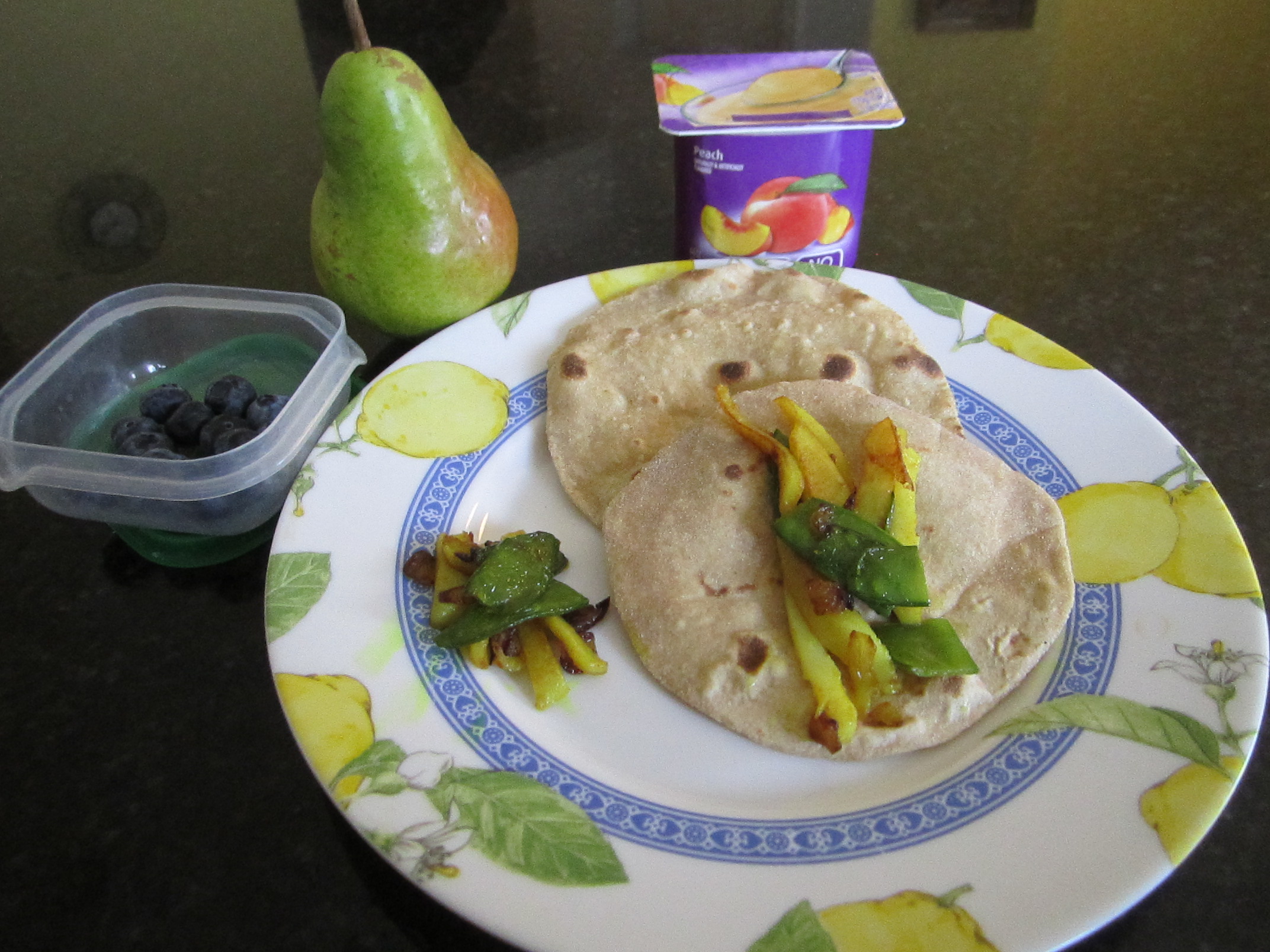
Desperately searching for a solution, I fell back on the lunches of my childhood, the soft rotis , the delicious stuffing that my mother would roll up in them; and I decided to try and replicate it. Since Kid 2 is constantly vowing to become a vegetarian “from my next meal”, I have to chosen a simple and easy vegetable dish that makes the lunch nutritious and yummy.

Easy Indian Vegetable Medley
Ingredients:
1 onion
1 potato
1 carrot
A few green beans/flat beans
2 or 3 stalks of cauliflower/broccoli
1 green chilli
1/2 tsp cumin seeds
1/2 tsp turmeric powder
Salt to taste
Method:
Slice the onion finely. The vegetables should be chopped fine, length wise. This ensures that all the ingredients are roughly the same size and will cook at the same rate so none are left too raw or overcooked. Any combination of vegetables will work but I have included our favorites, sometimes I have only two or three of these to hand but the recipe works just as well.
Heat oil in a pan. Keeping the heat at medium, add the cumin seeds (these are available at all Indian grocery stores and many regular grocery stores as well. if you do not have them, you can still go ahead and make this). When the seeds are toasted, they turn a darker shade and it is time to add the onions. Let them cook till they are soft and then add the vegetables. Toss all the ingredients together and let this cook for 2-3 minutes, stirring occasionally. Then add the turmeric (availability same as that of cumin) and salt ,and mix well. Cover and let it cook for about 5-7 minutes. Take off the lid and check to see if vegetables are tender but not mushy. At this stage you can add the green chilli, sliced in half, for a little bite if you like. Increase the heat and cook for a minute so the vegetables are crisp and bright.
I usually roll this up in a roti made at home with whole wheat flour. This can also be purchased at the Indian store or substituted with tortillas. Since the school day is long, this is supplemented with fruits and yogurt. Often, this is what I have for lunch as well.
The campaign runs through this week and even donating my weekly coffee budget would make a difference, and I certainly intend to do so.We have many choices for lunch, I intend to share this good fortune with those who have none and make a donation here.Please do consider it as well.
Posted in Hunger, Living, Nutrition, Uncategorized

Yesterday I discovered that Italians are no longer cooking at home like they used to and today I learn that those wonderful farmers markets of Paris are disappearing! Truly, the world of food is not what it used to be.Again, why? what has changed and led people away from the fresh produce, breads and cheese of the neighborhood market to the all in one hypermarche? Perhaps it is convenience, we are all pressed for time these days, or perhaps tastes have changed….
Have you been traveling or relocated and found the local food culture to be different from what is generally known about that country/region? If so, I would love to hear from you!
 Thought + Food