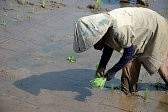
GM Foods have been lauded as the silver bullet that will save the world or reviled as “Frankenfoods”. The truth, of course, is at neither of these extremes. The Atlantic’s excellent article on Golden Rice shows a nuanced and ultimately winning picture. In particular, the public-private partnership that is guiding this project toward delivery of seeds to poor farmers, free of license, is a fitting reply to those who think that the word “Monsanto” is an adequate reason for their rigid opposition to the adoption of biotechnology.
Category Archives: Food Policy
GM Foods In a Different Light
Posted in Food Policy, Food Security, Nutrition
Tagged food policy, food security, nutrition
Biofortification
An insightful presentation on biofortification at the First Global Biofortification Conference in Washington D.C. It highlights the success story of the development of orange sweet potatoes in Africa. These sweet potatoes were developed using traditional cross breeding methods and are fortified with vitamin A, iron and zinc which prevents blindness and deaths from compromised immune systems.
Posted in Food Policy, Nutrition
GM Foods: another view
Time magazine has an interesting article on the GM foods that are already in the market. I wanted to post this because many people I speak to seem unaware that GM foods are already available and indeed, we have been consuming them already. The example of Golden Rice is important because it highlights a point often lost in angry din of the GM debate: genetic modification is a technology which can be safely used as so many other technologies are used. It is not essential that a giant corporation be the sole provider of this technology and hence gain monopoly control over the crop. Biotechnology can also be developed by research organizations, governments, non-profits etc. and the benefits of this technology can be reaped by farmers and consumers alike.
Posted in Food Policy, Food Security, Nutrition
Tagged food policy, food security, nutrition
More on the HFCS Renaming Issue
Much has been said about the HFCS renaming issue and I wrote about it earlier here. Much of it has been strident in the opposition to the change. How did all this start and how did we get here? James McWilliams of Texas State University writes in the Atlantic how one “viral sentence” as he describes it ignited this issue. He argues that instead of getting all steamed up about the name change, we should ask ourselves why high fructose corn syrup is so ubiquitous in the first place. The answer is massive government subsidies to the corn growers. Can we change that? And what would happen if we did? Very interesting read.
Also, an informative piece on the same issue by Marion Nestle at Food Politics.
Posted in Food Policy, Nutrition
High-Fructose Corn Syrup by another name…
….would be just as sweet! The Corn Refiners Association has applied to the FDA to change the name for High Fructose Corn Syrup to “Corn Sugar” on product labels. It seems that HFCS use is at a 20 year low as concerns about it become more intense (research shows a correlation between HFCS intake and obesity). In an attempt to boost sales,therefore, they want to rename the product. It is still the same product and our bodies will continue to metabolize it differently from cane sugar . But the industry hopes that enough people will be confused between cane sugar and “corn sugar” or will not try to research the ingredients in prepared foods ensuring that sales can continue to thrive. So, we are back to our favorite Thought+Food mantra: “Always Read the Label!”
Wheat Crisis Update
Earlier reactions on the Russian wheat crisis seemed encouraging. As I wrote then, the problem would be contained as other countries, apparently, were in a position to pick up the slack. Now the U.N. reports that the situation is somewhat volatile because consumers fear a repeat of 2008 with shortages and high prices. There is also increased hoarding and speculation fueling higher wheat prices. Such crises are going to be more common in the future with climate change playing a big role. Consider the situation in Pakistan where floods have washed away crops, and destroyed wheat seed stocks. The planting season is here and there is a dearth of seeds. In water-logged areas planting seeds, even if there are any available , is not possible. In a country where wheat is a staple food, this will unleash unmet demand and escalating prices which would have an impact elsewhere as well.
The Price of Sustainable Living
The FDA is going through the process of consultations and public meetings to ascertain if a newly developed strain of genetically modified salmon is suitable for human consumption. There are also reports from Europe on the success of breeding the endangered bluefin tuna. The first news was greeted by the usual scary warnings about “fish-zilla” and “frankenfish” while the second has been termed abhorrent because we are breeding the fish merely to satisfy our own greed. Let us set aside for the time being the question of the safety or viability of either technique and consider a very simple issue: the arrogance of a species that seeks to reorganize the planet to fit its own needs. We have eaten the bluefin to extinction and are reviving them to satisfy our appetites and we are trying to re-engineer the salmon so it grows faster to keep up with our demands. What if we thought instead about what we could be doing with humans? How about moderating our behavior instead? Instead of farming salmon fed on corn, we could we eat less fish and more plants. Or instead of finding spending huge amounts of money trying to breed a species solely to consume them, lets spend instead on creating awareness of the need to stop overpopulating the planet.
This is not fear mongering, we are on a slippery slope of no return so why is there no will to do what is needed? Because, sadly, a sustainable planet is the ultimate public good. We would all like it, no one wants to perish , but we figure there are plenty of others to make the sacrifices, the outcome will not depend on the actions of a single individual so we take the easy path out. So, very few people actually do the right thing and the possibility of a negative outcome grows. These are hard times, we say, give me a break. A break, a bargain, call it what you will, just inches up the price of a sustainable future for our children just that much higher and pulls it that extra distance away from our empty hands.
Think twice before you act and share your concerns with others, remember we need to get everyone to act responsibly.This is a huge task and its going to take a planet to do it.
Eggs-asperating!
Yes, I am referring to the salmonella outbreak and subsequent recall of millions of eggs. As an ardent egg devotee, I am appalled and as a follower of food policy issues, I am outraged. Here is why:
1. The regulations necessary to prevent outbreaks like this have been floating around for a decade when President Clinton was in office but have not been implemented.
2. A simple and cheap way to avoid salmonella is vaccination. It is done in the UK, for example, and the egg supply is very safe. However, it is not mandatory in this country and only about half the egg laying hens are vaccinated.
3. Who was in charge? No one. The USDA is responsible for plants and animals (but not for eggs) and the FDA is responsible for shelled eggs ( but not for the hens). So the infected hens who laid the eggs are nobody’s business.
4.Is this serving as a wake up call to Congress which is dithering over the Food Safety Bill? No. They are too busy working hard on your time and money trying to prevent banning BPA in plastics to actually pass the Food Safety Bill which would give some teeth to the FDA.
There is more on this issue here: in the New York Times. We all need to educate ourselves on this issue and also communicate our views to the people we elected.
From Farm to Bazaar to Supermarket
One of the highlights of buying produce in India was the bazaar experience. Vegetables were mostly sold in roadside stalls where, amidst the heat, dust and noise ( a lot of noise!), sellers would call out their wares and skeptical consumers would sniff, poke and scrutinize the produce on offer. Things are changing now with the entry of domestic and foreign corporate retailers who buy produce directly from the farmers to sell in supermarkets.As expected, this affects the growers in many ways: some lose potential customers, others face uncertainty as supermarkets buy what they please but do not enter into contracts with the farmers. The supermarkets prefer to deal with the big farmers so the small farmer; often a woman, as vegetables are mostly grown by the women in the farming family; is forced to the sidelines and unable to profit from the changing economic conditions. All this and more is explored in Sukhpal Singh’s piece in the Economic and Political Weekly. He also emphasizes the need for regulation, an uphill task anywhere in the world, it would seem.
The Great Locavore Battle
It’s on! The battle to define and support /oppose the locavore movement was kicked off today. Stephen Budiansky in his piece for The New York Times, “Math Lessons for the Locavore” while noting that he was all for growing your own veggies, pointed out what he calls the “absurdities” of this trend. The gauntlet was picked up over at Grist by Ken Meter of the Crossroads Resource Center who argued that the locavore movement is crucial to fixing our broken food system. Now, you be the judge! And stay tuned, there is more to come!
Posted in Food Policy, Food Safety, Food Security
Tagged food policy, food safety, food security