Tag Archives: biotechnology

Revisiting the “eat local” Idea

market

I just came across this review of a book called “The Locavore’s Delusion”, and yes, it is a nod to that other book, in case you were wondering! The authors of the book tried to answer the question: why did we start eating a more global diet anyway? The article gives a summary of reasons that most people offer for opting to eat local: more tasty, nutritious, helps local economy etc , and the most often cited reason: it is good for the environment. This has been the subject of much discussion (some of which I wrote about here) and the point at issue is that the contribution to greenhouse gases comes more from the actual cultivation of crops rather than their transportation.

The answer the authors provide to the query, why did global food trade develop, is that it provides increased variety of foods, reduced prices and stability of supply. They also argue that efforts to counter this are really an effort to turn back the clock with negative consequences. If a region was hit by unexpected weather events or pest infestations and the crops failed, there would be no relief available if we functioned as closed off food islands. Indeed, they see the problem as being one of inadequate globalization where subsidies, trade barriers and other distortions are hindering an optimum situation of low prices and assured availability of food.

Some of the discussion here has been heard before but I liked the way the question was posed: why did we start expanding out of the local market? Perhaps we could ask the same question for the GMO question: why did we start developing them in the first place? Was it because some evil people were working up weird stuff in their labs and injecting it into food to try and rule the world like in some bad movie? No, it was because we need to tackle pests to stop crop loss. We will need it in the future to combat climate change. Imagine a flood event that submerges crops. Since genetically modified crops that could withstand the submersion were not planted, there is no food. But there is also no way to acquire it from anywhere else because food trade has given way to purely local markets. It could happen….


(Image Courtesy: freedigitalphotos.net)


Will There Be A Second Green Revolution?

paddy

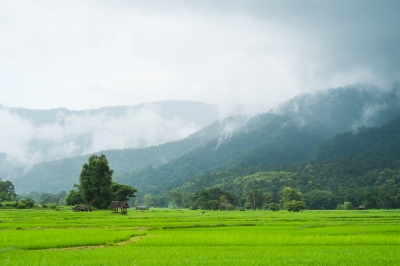
Last week, The Economist published a piece on the possibility of a second Green Revolution on rice fields in Asia and Africa. The possibilities outlined in it make one hopeful for the future, at a time when stasis on climate change and polarization among the players in the food system usually make for a grim outlook.

The second revolution, if it comes, will be crucial in feeding the growing population as current yields are dropping off from previous levels. And what is remarkable is that the increase in yield required to meet demand can be obtained almost entirely from areas missed by the first Green Revolution. This is because, the green revolution took off in irrigated areas while passing by the rain dependent regions. These areas fall in the marginal category where harvests are often disrupted by drought or floods. Now, the International Rice Research Institute is  offering farmers a rice variety that stays dormant during long periods of flooding and then resumes growth. This would be an invaluable trait for dealing with the possibility of increased rainfall and  flooding due to climate disruption. And, because this offers the possibility of increased production on marginal lands, the impact in terms of greater income would go to the most vulnerable sections of the rural poor whose impoverishment is a result of their dependence on unproductive land.

But how was this new strain of rice developed? The scientists at IRRI had identified a rice strain from Odisha, in eastern India, as having a high flood tolerance. This was then crossed with other rice varieties but the experiments were not successful. Finally, the scientists identified the gene that enabled flood tolerance, and spliced into other rice varieties, to achieve more than a dozen varieties of rice , all flood tolerant and collectively known as “Sub 1”.This is what was so striking for me: decades of traditional breeding saw no success, yet once the genetic sequence of the rice from Odisha was marked, it took only four years for flood tolerant seeds to be produced!

This presents a promising option for making agriculture resilient to future climatic uncertainties in a short period of time, in addition to increasing production on marginal lands and providing income opportunities for the rural poor. This would be a revolution indeed! The article is here and an interesting account of the farmers growing Sub 1 rice in Odisha is here.

(Image Courtesy: freedigitalphotos.net)


Smallholder Farmers Most Vulnerable to Climate Change

cofcl For some time now, we have been aware that coffee farmers have been facing the challenges of climate change; either from too much rain or from drought. Coffee crops are also being attacked by coffee rust which thrives in the warmer temperatures we are experiencing today. Colombia was one of the countries worst affected by this issue but the Colombian Coffee federation has invested on a large scale in rust resistant varieties, thus providing a solution and some hope for the farmers. In Brazil, large coffee producers have moved operations to cooler areas to combat the rising temperatures. But lost in all this is the small holder coffee farmer, often the supplier of the fair trade coffee we prefer as a better option for the planet.

While our choice at the cafe makes us feel we did the right thing, the reality might be different, with the farmer often at the losing end of a deal with middle men and has limited access to resources to deal with the problems facing coffee cultivation. This is an important consideration in any discussion on climate change: the bigger economies/groups with greater resources will at least have the chance to adopt some measures to combat the impact of changing climate; but is is those with the least resources and access, whether it is nations or communities within a country that are most at risk.

Also, can we acknowledge that climate change is not like any other problem that we have faced in the past? It is a challenge to the way we have lived on this planet for so long and its impact will be colossal so it is only logical that we employ all options to deal with this crisis. Those small holder coffee farmers facing the prospect of losing their livelihoods could benefit from solutions offered by biotechnology. In a better world, we would  be open to options that science can offer and not be held back by unfounded fears. At this point, the future looks pretty grim, we are going to need some coffee to deal with that!


Image Courtesy: freedigitalphotos.net


Water and Technology in Farming

irri

This post grew from a discussion on Twitter about the state of Indian agriculture. Why, it was asked , would young people, choose to work on farms when they could get less demanding and higher paying jobs in malls and call centers in the cities? Perhaps, technical innovations that would increase productivity and income might make farming a better career choice? Then it was noted that Indian agriculture continues to remain dependent on the monsoons for water and new technology might provide some solutions.   By a curious synchronicity I came across this article on Peruvian farmers using modern technology and older knowledge to deal with climate change that makes rainfall erratic.

The indigenous communities were struggling with new conditions which meant that rainfall came in short, intense bursts and the soil does not retain enough water for pastures or subsistence crops. The weather that they collaborated to collect with the aid of technology painted a bleak picture of an uncertain future for rural communities.The solution: to build water reservoirs similar to those used by the Incas.

What struck me most in this piece is the development and sharing of this knowledge by the community members themselves. Also, the recognition that this program is only a part of the solution. Climate change is going to require a huge and varied effort from all of us, from the farmer in rural Peru to those who are reading and sharing these stories in urban settings. There is no magic wand, no perfect solution, we must try all that we know (including genetic modification) without prejudice.

As I was writing this, I remembered reading about an app that alerts the farmer to when and how much water is needed. I had forgotten to bookmark the source so I decided to search for it and here is the first page of search results!  I had no idea that there was such an array of options available at the swipe of a screen! How accessible and relevant are these for the farmers in Peru or India? That will be explored in another post: do share your experiences and stories in the comments , it would be great to include those as well.

(Image Courtesy of FreeDigitalPhotos.net)


“The Lowdown on GMOs: According to Science” Book Review

21263374-leaf-in-test-tube

The use of biotechnology in agriculture is a topic you hear  a lot about these days: farmers in distant regions of the world, looking to improve their yields, receive two versions (this will save you/this will poison you); voters in conditions altogether more comfortable than those small holder farmers weighed down by debt, are driving up to vote on whether products should be labeled to let consumers know they were grown using biotechnology. All of this and more is contained in 3 letters GMO (Genetically Modified Organisms). But what exactly does this mean? To anyone advocating for food policy issues, the superficiality of information (or, in some cases, complete misinformation) which form the basis of debates on GMO are held is worrisome.  So I am happy to be the bearer of some good news: “The Lowdown on GMOs: According to Science” by Fourat Janabi  is here and is going to be an excellent source of information for anyone seeking to learn more about this issue.

The book is put together with articles from a range of experts in this domain:  molecular biologists, Alan McHughen and Kevin Folta ; plant pathologist Steve Savage and plant geneticist Anastasia Bodnar, among others. The scientific viewpoint, often so frustratingly opaque to those of us who were relieved to be done with science on high school , is presented here in clear terms and the reader can come to their own conclusions.

Also interesting are the accounts of  the journey of those who started out as skeptics but after doing the research became convinced by the actual facts to support the use of biotechnology in agriculture. This is specially useful because it resonates with those of us who may still be educating ourselves but feel intimidated by all the noisemakers into taking up a hasty position. This perspective is a nuance often lost in the noisy and often vicious debates that characterize this topic. It also helps that one of these journeys is that of Mike Bendzela  who is a farmer. That farmers’ voices are not heard often enough in the food debate is something I have often blogged about. You may think you know all that is there is to about Monsanto, but after reading Brian Scotts’s views on using Monsanto’s products on his farm, you might look at the picture differently. Of particular note is the piece by Mark Lynas, the British journalist and environmentalist who recently changed his viewpoint and came out in strong support of GMOs

In his own piece, Fourat Janabi replies to the “Nature does it best” argument that the anti-GMO lobby is so fond of, pointing out that nature is full of experiments which created our diverse world; also drawing our attention to the fact that the Big Ag lobby is matched by a robust Organic lobby!). He also takes up the question of how to feed 9 billion people in a time of climate change and it is here that biotechnology is going to prove crucial. The use of biotechnology can increase yields, enable climate resilience and improve health outcomes through biofortification of crops . It is not the only or perhaps even the most important tool but it is a crucial one and throwing it away on the basis of misinformation and fear mongering would be a grave mistake.

The conclusion consists of an impressive list scientific bodies from all over the world that have found that biotechnology is no more risky than any other conventional breeding technology and is safe for human consumption; hopefully this book will convince many people of that point of view.

“The Lowdown on GMOs: According to Science” has been published by Smashwords and is available, free, in a variety of formats here.