Category Archives: Uncategorized

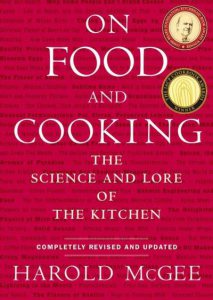
On Food and Cooking: The Science and Lore of the Kitchen, by Harold McGee

Reading about the science of cooking…

Barry's avatarBlogging for a Good Book

mcgeeWriting yesterday about Michael Pollan’s Cooked got me thinking about other great books about food and its preparation. In my mind, Harold McGee’s masterful On Food and Cooking is the best writing I have found on food, covering chemistry, preparation, taste, individual fruits, vegetables, fish, cheese, meats, and pretty much anything else you might eat—algae anyone?

Whether you want to know about sugar substitutes and their qualities (p. 660-661), how baking pans affect the qualities of the item being baked (p. 563), what drinkers mean when they talk about the “tears” in strong wines or spirits (p. 717), or how you get from tea leaves to black, Oolong, or green tea (both Chinese and Japanese) (p. 438) there is something here for you.

Along the way, McGee includes recipes, food lore, quotations, and more, but the heart of the book is the comprehensive exploration of how cooking, fermenting, and other…

View original post 187 more words

#Farming Friday 24: Would You Want To Be A Farmer?

ID-100193367

Across the globe there is concern over the greying and emptying of the farming landscape. Younger people leave for cities to look for better paying opportunities and easier working conditions. When people bemoan the loss of the family farm (never mind that family farms are still the norm in most parts of the world as well as in the US), they often do not focus on the reality of working on a farm, that it is hard work without holidays in often uncertain weather conditions, with modest returns; and sometimes not even that, leading to the high incidence of farmer indebtedness in some countries. So what is the solution for rice farms in Japan where the farmers are well into their 70s and 80s? If 20 year olds do not perceive farming as a viable option, could private companies provide the answer?

All of us, worrying over our produce, counting the calories, searching for possible gluten in everything, need to know what it takes to grow our food. This piece in the Huffington Post seemed to do just that, explaining what it takes to grow rice. I used to think that this is what the food debate needed, a clear look at the production of food rather than the obsession with the plate. But the last line of that piece implying that just reading about growing rice is so exhausting that you need a hot bowl of rice to feel restored leaves me unconvinced.

“Organic” is a misleading label. Here’s how technology could create something better

This is a must read: it put the “organic” label in perspective and moving from the history presents a peek at what the future might hold, exact information based on real data. In all the debates on labeling I was not comfortable with one particular label being imposed. If it is information that consumers want, let us give all the relevant information and then have them decide which features are most important to them.

What is food?

This post asks an important question, one we think we know the answer to but it really requires some reflection. It also reminded me if what the grandmothers used to say “Pay the grocer or pay the doctor”. It is crucial we understand the real value of food.

britishseabuckthorn's avatarThe British Sea Buckthorn Company

The advent of the Nutrition and Health Claims regulations came about because there was concern amongst regulators and politicians that products were being sold in the European market with health claims that were false or unable to be substantiated by science. From that moment on regulators made it clear that in their view food is not a medicine.

A medicine is defined as a drug or other preparation for the treatment or prevention of disease. Over the past fifty years the pharmaceutical and retail industries have developed a readily available selection of drugs for minor ailments that keep us away from doctors. Pills or a course of anti-biotics have become part of life as the means to allow us to carry on with our lives without being troubled by minor illnesses.

Food therefore has become a means of providing the fuel to keep us going. Product nutritional detail is angled…

View original post 902 more words

Cyprus’ ongoing conflict has a new victim: halloumi cheese

No matter how many times boundaries are redrawn and countries refined, the “idea” of food, a certain flavor, an aroma, memories of preparing it with friends and family are hard to fit into little bureaucratic boxes!

#Farming Friday 21: Student Farmers

ID-10046584

From Bend, Portland and Broadway, Virginia, stories of students learning to raise and butcher hogs and seeing the process of getting meat to the table from a new perspective.


(Image Courtesy: freedigitalphotos.net)

Goodbye Emad Asfour, Slow Food in Gaza

Reflections on war and food….

Kitchen-Counter-Culture's avatarKitchen Counter Culture

Dear Slow Food friends, 

One of us has been killed in Gaza.

His name, Emad Asfour.

Here’s what Slow Food founder, Carlo Petrini wrote.

As for me:

One power it would seem is to use my social media and blogging to express a strong conviction that the methods and outcome of Israeli military might in Gaza, and Palestine, is definitively wrong.  And encourage others to do the same.

I didn’t know Emad Asfour, but when someone dies– killed by a bomb– and that someone shares things with you, you grieve.

I have tried to think through what’s happening in Gaza this past month through the lens of a cookbook called The Gaza Kitchen, and the work of Zaytoun, a Fair-Trade local-produce company working to ensure UK markets for Palestinian produce.

Through all the death, destruction, carnage, uprooting– I’m also thinking a little about the small gardens people plant, the rabbits, the bakeries…

View original post 26 more words

ISAAA publishes Brief 47: The Status of Commercialized Bt Brinjal in Bangladesh

On the progress of Bt Brinjal (eggplant) in Bangladesh

Quinoa isn’t the only ancient crop falling prey to Western gluten-free appetites

I am always bemused with the sudden obsessions with some ancient grain, presented as the answer to all health issues. As consumers chase the grain of the moment, one wonders how this impacts those people who have been growing and consuming this over centuries? Here they were, “eating local” and minding their own business, and now the market explodes, prices spike and they have to rework their lives and diets. Here is an idea: there is no one single miraculous solution, if we look closer around us, chances are we will find healthy options here as well. After all, it is not as though , in the past people collapsed into globs of gluten because they did not have access to quinoa. What food choices did they make that could hold lessons for us? Distant vistas often look more alluring but what is close by might be just as beautiful, it merely requires us to refocus.

Wordless Wednesday: Farm Kid Summers

What do farm kids go in summer?

illinoisfarmgirl's avatarRural Route 2

Farm Kid SummerFrom author Michelle Houts new book The Practical County Drama Queen:

“What Sarah Cuthbert and other town kids just don’t get is that farm kids have a life beyond the swimming pool. But, that’s okay. I’ll try to make it there once or twice, just to see people and show that I’m not a complete and total farm nerd.”

How true. How true. During my childhood, I spent more time with my cows or in the garden or in the fields than at any typical kid-friendly summer activity.  And this summer, in particular, my farm boy is doing the same.  Farm kid summers are different and that’s okay.


View original post