Category Archives: Uncategorized

How Will the Election Impact Agriculture Policy

With the elections almost here, it’s interesting to look at the possible impact on agriculture based on the positions and priorities of the two campaigns.

The Harris-Walz campaign promises investment and action to strengthen rural communities: medical care, schools, Internet access, supporting small farms, and new farmers, and promoting diversity in farming. This is positive for rural areas that typically lack access to the infrastructure and services more easily available in urban areas. They also aim to promote crop insurance, expand farmland protection programs, and ensure farmers’ right to repair equipment.

A new Harris administration can be expected to maintain continuity with current policies committed to promoting equity and supporting climate smart agriculture: reducing emissions, climate resilience and enhanced productivity. Will this involve support for the adoption of agricultural biotechnology and combat the surrounding misinformation? Food security in climate uncertain times needs all options and tools. It is hoped that the new administration can harness the potential of agricultural biotechnology and ensure that public policies are fact-based.

The Project 2025 document lays out the agenda for the Trump-Vance campaign. It starts with the contention that American agriculture today is a flourishing role model for the world and the main obstacle to future growth is unnecessary government intervention. From this it goes on to list all the ways in which the USDA and its programs need to be limited. 

It is skeptical of the climate smart approach and advocates for delinking from the UN goals of sustainable development. The goal would be to put food production ahead of all other goals. Since  the biggest challenge to food production is the impact of climate uncertainty, eliminating that as a consideration seems questionable.

The USDA is also expected to remove foreign barriers to trade. How would they do this in the event of expected retaliation to the tariffs the campaign is proposing?

It is also asserted that American agriculture needs to be defended against the transformational policies of the Biden administration which are barriers to food production. It is not clear how these are barriers, other than mostly every current policy measure is opposed.

Reforms are proposed to a range of programs such as farm subsidies, the SNAP and WIC program, repeal of the Federal Sugar Program, elimination of the Low-Income Heat and Energy Assistance Program, and removing the nutrition responsibilities of the USDA.   

The School Lunch Program is described as one of growing entitlements benefitting higher income families.  This is not reflected in the lived experience of most people.  In some areas, school meal programs have been expanded through summer to help food insecure families. Like other developed and developing countries, we need to improve the quality of meals and make it available to all, both to ensure better educational outcomes (hungry children cannot learn), and to ensure that school is a place which provides equal access to learning, play and good health for all children.

Strong support is noted for agricultural biotechnology, including efforts to combat disinformation and to remove barriers to trade related to agriculture biotechnology.  To acknowledge  the utility of this technology and yet ignore its potential for promoting climate resilience (because of turning away from climate relevant policies), seems a strange disconnect.

While the Harris program can be expected to bring improvements to the rural economy, the broad elimination of services and programs envisaged by Project 2025 is likely to have a much deeper negative impact on the rural economy. 

The approach laid out in Project 2025 that does not recognise the challenge of climate impacts, and is set on limiting access to food, is not in the interest of maintaining food security as a nation.  The Harris approach which recognizes the challenge of climate uncertainty and supports access for all is likely to have a more effective  plan to ensure food security.

Image: Acroterion, CC BY-SA 4.0, via Wikimedia Commons

Recipes in Books (not recipe books!)

gaelle-marcel-560818-unsplash

One of my earliest food-book-memories is Enid Blyton’s description of the children in her book enjoying anchovies on toast. Fish on toast? I couldn’t quite understand why this would be such a treat, I preferred my fish in a curry, but I promised myself that I would try it out one day.

While I never got around to that, Valerie Stivers, in this immensely enjoyable series, does just that: cooks up recipes from the books of different authors. What caught my attention first was her piece on Iris Murdoch’s “The Sea, The Sea”. My father recommended this book to me when I was in college. I read it, and then everything else by Iris Murdoch that I could find. The meals described here, I remember dimly, as somewhat weird, because they involved food in cans. Canned food was not common in India at that time. While it did not sound appetizing to me, it turns out that is exactly how Ms. Murdoch and her husband actually ate! Ms. Stiver recreates it with interesting results.

While most cookbooks weave a story around the recipes, I am more intrigued by the foods that are mentioned, sometimes just in passing , as part of a story.  Lembas bread in “The Lord of the Rings” seems to evoke a lot of questions among readers I have met, and online as well.

The book I am reading at the moment, “Pachinko” by Min Jin Lee describes  a beautiful moment between a mom and her daughter, herself a mom worrying about her sons. The daughter cannot sleep and gets up in the middle of the night to make the candy she will sell the next day. Her mother joins her, they share their thoughts as the black sugar candy cooks and cools. I wonder what black sugar is, turns out it is sugar containing molasses, sounds like it would be a great recipe to try….


(Photo by Gaelle Marcel on Unsplash)


Taking Up a New Food Tradition: “Hoppin John” on New Year’s Day

Looking back through old posts, I found this discovery of a good luck tradition for new year’s day which has now becomes a tradition! Black eyed peas are a favorite in my home and it was great to read some encouraging news about a new variety of cowpea , ready to be introduced in Nigeria. The cultivation of cow peas has been hit by the pod borer and required heavy application of pesticides. The new variety is modified to resist insects and will bring down the use of pesticides. This is better for the environment and brings down costs for the farmer as well. the consumer also benefits as a great source of protein becomes more accessible. From the Cornell Alliance For Science:
https://allianceforscience.cornell.edu/blog/2017/11/gmo-cowpea-offers-hope-for-boosting-nutrition-economy-in-nigeria/

Thought+Food's avatarThought + Food

FullSizeRender (1)

Though I have lived in the US for  a while now, I just learned about the tradition of eating “Hoppin John” on New Year’s day. The first description I read of it involved black-eyed peas, pork, rice and some greens. The black-eyed peas represent coins and the wish for prosperity, the greens of course represent cash. This immediately reminded me of a favorite recipe from India  and I thought I would use it. And so our first meal of the year was this bowl of golden goodness, glowing with turmeric and a little chilli powder, with a sprinkling of cilantro standing in for the greens. To me, this represents the best of all possible worlds, memories of the infusing the adventure of the present.

Further reading brought interesting facts to light: the original dish used red cow peas not the black-eyed peas used today; the rice used was  Carolina…

View original post 135 more words

What’s In a Label? Not What You Might Expect….

Does it feel like grocery shopping takes a lot longer these days? It is not that the stores are bigger or the lines longer. It is because every product comes with so many labels that reading all of them doubles my usual shopping time! Even a quick run to the store to get some milk can become quite an experience as I discovered the day.

As I reached out to get my usual gallon of milk a new product placed close by caught my eye:

IMG_0006

The blue and white of the bottle was similar to the cartons of milk but then I saw the “non-dairy” and thought oh, not milk. But wait, it then says “milk protein”. By now, I was thoroughly confused, re-read the whole thing and discovered it was a liquid derived from peas. Protein from vegetable sources is great for the diet but they are not “milk” even if the product is a white liquid. In case you are interested, it does not taste like milk either and not something that makes a natural pair with your cereal of choice.

Much space on the label was devoted to what it was not:

IMG_0001 (1)

This is part of the upward trend in “absence labeling” where the information on the label is not about what it contains but what is not there. Companies say this is because consumers are “worried” about their food and need to know what is in their food. IN reality, these labels are all about what the food is not, playing into consumers’ fears and not based on fact. Why talk about what is not there other than to imply that had that ingredient been there, it would have been harmful to the consumer? This fear mongering to garner profits by driving consumers away from competing (but completely safe) products undermines trust in our food system and leads to higher food costs and lower agricultural productivity.

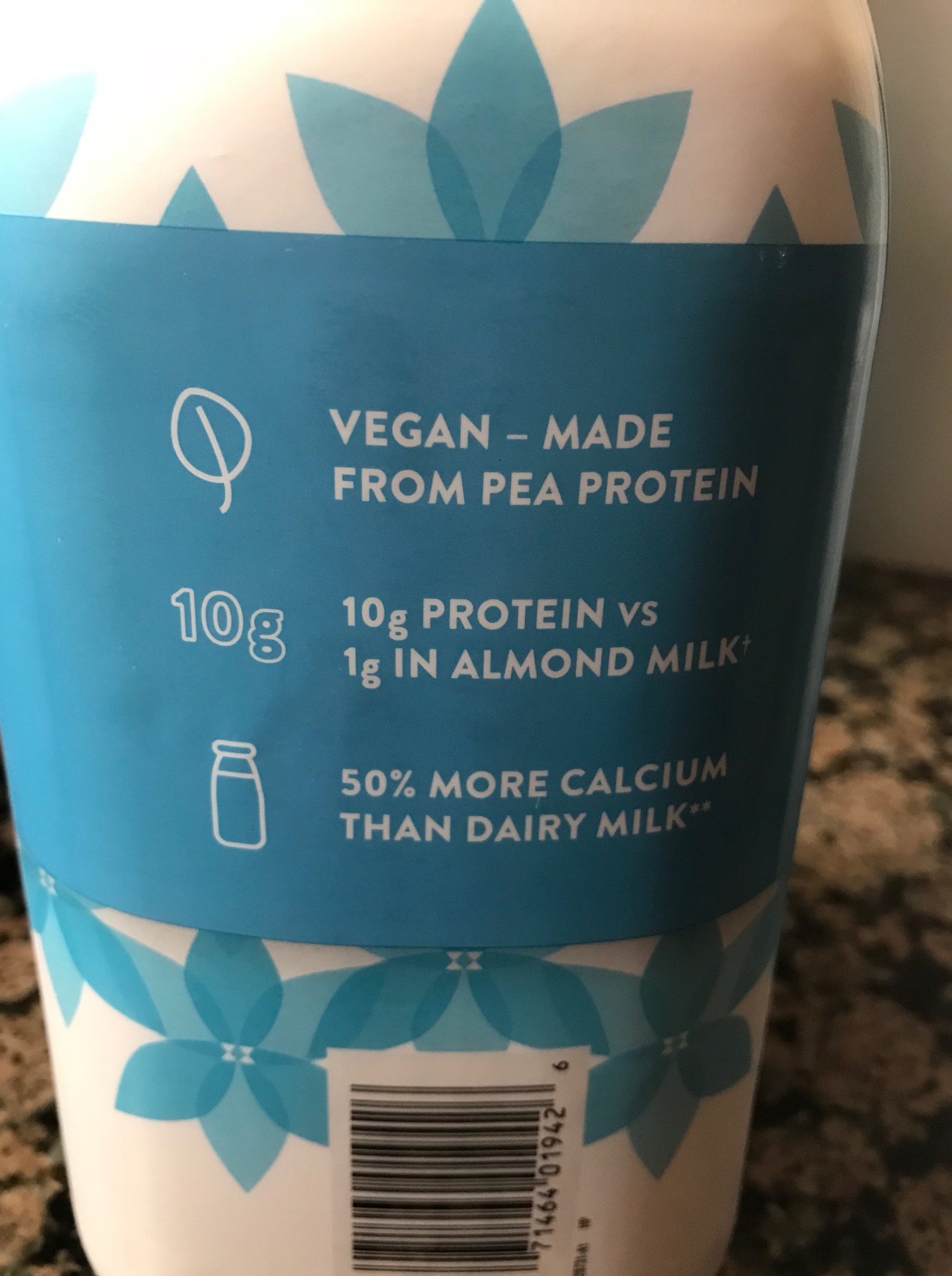
A good product should be able to draw consumers on the strength of the advantages it offers, not by vilifying other products. So what did this product say about its strengths?

IMG_0029

It is “vegan-made” so made from vegetables. Why not simply call it a vegetable protein source?  It contains 10 g of protein as compared to 1 g of almond milk. It would be interesting to know how that compares with soy milk which in the non-milk category comes out as best in a recent study. That study also found that most of the non-milk products do not provide the same level of nutrients (or inhibit the intake of nutrients). It also has 12 g of added sugar, not found in milk.

I am curious about the calcium content that the label asserts and will be looking more into it. Two sources I looked at, one from the National Institutes of Health and another from Harvard Medical School do not list peas as a notable source of calcium.

And, of course, it is “non-gmo”. No GMO peas are grown anywhere, nor is there any GMO milk so this essentially highlights something that is not relevant to the product. It links into the prevalent misperception that, had there been any “GMOs”, that would have been a cause of concern.

This might seem trivial but it does have two important consequences: it will impact your food budget because that product will cost you more than regular milk or conventional version of the product. For consumers working on a constrained budget, this product might not be an option. If they have heard all the fearful talk around GMOs, they would worry that buying a different product might impact their family’s health. This is not the case and the worry is needless.

Now consider a country where peas are the most important part of the daily diet. The pea crop is crucial to the country but is being devastated by a pest. A genetically modified variety of peas has been developed by scientists, farmers are eager to try it out and avoid huge income losses, but the government, under pressure from groups that have heard that GMOs are harmful, refuses to allow the crop to be grown. This information comes from countries where food is plentiful and people have choices. But in our imaginary country, crops fails, family incomes are devastated, food insecurity rises. For that country, pest resistance would have been a potential solution which is now foregone because of a label that was created simply to sell a product and not to give accurate information.

Weekend Reading: “The Food Police”

FullSizeRender

“Today, food policies are increasingly motivated by ideology rather than projected economic consequences. The merits of a policy are primarily judged not by whether they benefit all the people affected but by whether they advance the fashionable agenda of a new food elite”.

This is going to be an interesting read….

#Farming Friday 54: Building Climate Resilience in Fiji

food-healthy-vegetables-potatoes

Cyclone Winston hit Fiji in 2016 and the days of rain that followed led to widespread erosion and crop loss. This was not an isolated event. In fact, warmer ocean temperatures are creating more intense flooding and storms than in the past. To the farmers here, climate change is a reality they have to deal with in the present, not something to be discussed about for the future.

The solutions that came up ranged from terrace farming and diversification of crops, to back up gardens and cooperative banking; options that might prove useful as farmers the world over face climate uncertainty.

#Farming Friday 53: India’s Cotton Revolution

Cotton_field_kv37

(Image : By Kimberly Vardeman – Flickr: Cotton Harvest, CC BY 2.0, https://commons.wikimedia.org/w/index.php?curid=17157722)


Worsening conditions on the farm led an Indian farmer to participating in Bt cotton trials. Increased pest pressure was resulting in low and poor quality yields.

“We were losing money and slowly getting into debt. We saw no way out and every time I would get together with other farmers, the only topic of discussion was how to survive. I thought I’d have to give up farming.”

Instead, by adopting Bt Cotton, Balwinder Kang was at the forefront of a cotton revolution, thanks to the seeds that could withstand pests. Read his story here.

As of December 2017, India leads the world in cotton production.


#Farming Friday 52: How the Rice Straw Went from Waste to Value

ID-100298150


A great story I had to share! Research in Vietnam found alternative to burning rice straw: it can be used as a growing medium for mushrooms. Consequently, rice straw prices are high, and mushrooms farmers are benefitting by increased production as well. The huge added benefit is the lowering of pollution which used to result from burning the rice straw.


(Image Courtesy: annankkml, freedigitalphotos.net)

The Role of Food Markets in Society

id-100441594

The way we buy our groceries and prepare our food has evolved over time. As people started settling down and bringing produce to sell and exchange with others, markets became the central civic space for social interaction.  When cities developed, the  process became indirect involving traders as middlemen, that link grew weaker and in the era of the modern supermarket, there is virtually no human interaction at all. Even cooking is an optional activity with stores doing huge business in ready to eat meals. This piece suggests that farmers’ markets, community gardens, urban and backyard gardens would bring back that social engagement.

The idea is interesting despite some assumptions such as the identification of fresh and organic food with farmers’ markets, and conventional produce coming from industrial farms. According to the USDA,  97% of the farms in the US are family owned and organic produce is readily available in most supermarkets. While the popularity of farmers’ markets has certainly risen in recent years, recent research found that, of the different options for food sourcing, farmers’ markets were the least preferred. So while they do not fulfill all the requirements for grocery shopping, the reason for their proliferation might just be the social setting they provide.

(Image Courtesy: “Fruit on A Wooden” by start08, freedigitalphotos.net)

Thoughts on the newly nominated Ag secretary from a farmer: Who Is Sonny Perdue?

I’ll admit when I heard that Sonny Perdue was nominated as President Trump’s pick for the USDA Secretary I was a bit underwhelmed. Perdue’s name had been floated around for months, I wasn’t personally familiar with him, and all I knew was that he was the former governor of Georgia. But now that he has been nominated and I’ve done Continue Reading

Source: Who Is Sonny Perdue?