Category Archives: Farm Technology

Can a Rice Gene Save the Banana?

r2


Can a gene from rice help combat the pathogen that threatens the extinction of bananas? That was just one of the many interesting issues featured in Dr. Pamela Ronald’s lecture at the SAIS Global Issues in Agriculture series. Dr. Ronald is a plant geneticist at the University of California, Davis. Many of us following the debate on GMOs  might have read her book, “Tomorrow’s Table”, co-authored with her husband, Mr. R.W. Adamchak, who is an organic farmer.

Speaking to a (mostly) non-scientific audience, Dr. Ronald explained in clear terms that growers have been trying to enhance desirable traits in crops forever. The older method of simply crossing Type x with Type y and waiting to see whether the hybrid plant had the desired trait . This method focused on the outward result but modification at the genetic level did take place but was unobserved. Genetic modification today is precise,  and efficient and enables quick and accurate results. In addition, it is backed by years of research data.

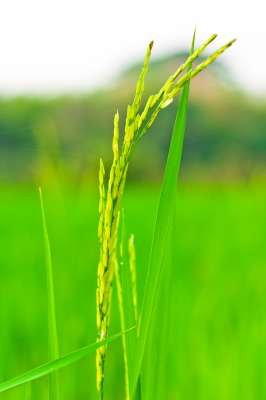
Why do we need genetic modification anyway? Consider, Dr. Ronald said, the case of the GM papaya. The papayas grown in Hawaii were attacked by the ringspot virus which devastated the crop, even moving the crop to another island did not help. Ultimately, the plants were “vaccinated” with a dose of the virus which enabled them to resist when the virus actually attacked. And so it is that we still have papayas in Hawaii. Perhaps a similar solution could be found for coffee rust? We will never know if we cannot try this option in the real world. Dr. Ronald spoke of her own work with rice: how a rice gene could possibly be used to battle the pathogen which threatens  bananas with extinction.

One possible application of genetic modification could be in building climate resilience in crops.Dr. Ronald shared her work on building flood tolerance in rice. In many parts of the world rice is grown in flood prone areas and with increased flooding possible from climate change; the development of a strain of rice which can stand water logging for up to 17 days as compared to the current maximum of 3 days is great news. But all these wonderful possibilities would take years to negotiate the stringent regulatory process and even then be opposed due to fear mongering. In that context, I was hoping to ask Dr. Ronald for her views on labeling of GMO products. But , sadly, there was not enough time; most of the discussion was taken up by two journalists from Germany, which, given that country’s staunch opposition to GMOs was interesting….

The main point to learn from this lecture was that the seed (around which so much of the storm is swirling) is but a small part in the whole process of growing food and we need to incorporate all options, technology and good agro-ecological practices to achieve sustainable development.

While I was learning all this; with ease, I would like to add, as Dr. Ronald is great at making all this scientific information accessible to those not from a science background; I wished more people could hear her, instead of being bombarded by myths of “dangerous farming” and GMOs killing bees.
#Farming Friday 4: Difficult Choices for Small Farmers

In this installment of Farming Friday, a farmer in Colombia talks about his dilemma , to eat or sell what he grows and the constraints under which he works.

#Farming Friday: Who Controls the Seeds?

seeda

One of the issues in the GMO debate that seems to concern people a lot is that of corporate control over seeds. In today’s Farming Friday, a  farmer talks who uses both GMO and non-GMO seeds talks about his choices and decisions.

Image Courtesy: Freedigitalphotos.net

Water and Technology in Farming

irri

This post grew from a discussion on Twitter about the state of Indian agriculture. Why, it was asked , would young people, choose to work on farms when they could get less demanding and higher paying jobs in malls and call centers in the cities? Perhaps, technical innovations that would increase productivity and income might make farming a better career choice? Then it was noted that Indian agriculture continues to remain dependent on the monsoons for water and new technology might provide some solutions.   By a curious synchronicity I came across this article on Peruvian farmers using modern technology and older knowledge to deal with climate change that makes rainfall erratic.

The indigenous communities were struggling with new conditions which meant that rainfall came in short, intense bursts and the soil does not retain enough water for pastures or subsistence crops. The weather that they collaborated to collect with the aid of technology painted a bleak picture of an uncertain future for rural communities.The solution: to build water reservoirs similar to those used by the Incas.

What struck me most in this piece is the development and sharing of this knowledge by the community members themselves. Also, the recognition that this program is only a part of the solution. Climate change is going to require a huge and varied effort from all of us, from the farmer in rural Peru to those who are reading and sharing these stories in urban settings. There is no magic wand, no perfect solution, we must try all that we know (including genetic modification) without prejudice.

As I was writing this, I remembered reading about an app that alerts the farmer to when and how much water is needed. I had forgotten to bookmark the source so I decided to search for it and here is the first page of search results!  I had no idea that there was such an array of options available at the swipe of a screen! How accessible and relevant are these for the farmers in Peru or India? That will be explored in another post: do share your experiences and stories in the comments , it would be great to include those as well.

(Image Courtesy of FreeDigitalPhotos.net)


Of Organic Eggs and Antibiotics

soft-boiled-egg-in-a-white-cup-100150684

Reading this piece on organic eggs today I was  reminded of the famous painting of a pipe by Rene Magritte, entitled “Ceci n’est pas une pipe” or “This is not a pipe”, it is merely the representation of a pipe. Or, nothing is what it seems. In the piece, it is revealed that organic eggs are treated with an antibiotic, gentimicin. This is actually used to seal in the tiny hole made to vaccinate the egg against Marek’s disease. This is done on the first day of the life cycle of the egg. But to be classified as “organic”, the egg only needs to be free of antibiotics from the second day of life so this egg will go on to hatch and the eggs from that chicken will come to our tables. Is this still an “organic egg”?  (The organic eggs sold for consumption are, however, not treated with gentimicin). How does this make us feel about the categorization of these eggs as organic?

For me, it is reminiscent of the bump down to earth I felt when I discovered that the organic strawberries that my toddlers loved, and that I paid a hefty premium for, actually started life in the nursery doused with methyl bromide, soil sterilizer and pesticide.  At the time of this report, two years ago, there were no organic nurseries in California which provide fruit and seedlings to consumers all over the world. Yet some would opt for the organic produce from those very seedlings over conventional produce and pay more for it. Are they really getting “organic strawberries”?

The intention here is not to devalue organic methods but to underline the fact that debates on the food system are often disconnected from ground realities. Seedlings, eggs etc will be prone to pests and diseases and we have to find a way to protect what we grow. Insistence on some arbitrary “natural” , or “local” standard ignores the fact that pests do exist in nature and crops have to be protected from them. This insistence on unreal qualities is then exploited by retailers who will use terms like “natural”, “local” or “sustainable” which actually have no backing or meaning to them, on labels  and make a profit by selling a higher quantity.

As the labeling war wages on in different states, it might be a good idea to pause for a moment and reflect on what it would achieve. If current labels mask loopholes, would future labels be of any value? More importantly, is it going to be worth the time, money and resources that are currently being directed into this contest? There are much bigger problems we need to attend to: too many people going hungry , too much food being wasted, sources of water running alarmingly low levels, unpredictable climate posing challenges to our current ways of growing food; all of which  need our energy more than semantics.

Non-GMO Cheerios: Something to Cheer About?

28047578

The news that General Mills is going to eliminate genetically modified elements from their line of Original Cheerios was greeted with cheers by many. If true, it would represent a big change in the way the cereal is produced. But how big is this change, I wondered.  Reading closely we find that the main ingredient, oats, were not GM anyway, it is the corn starch and sugar that are being sourced differently and this will only happen for the Original line not for others like Honey Nut, Fruity Cheerios , Apple Cinnamon etc. It is, then, only a small tweak in only one cereal, right. Wait, there is more: on her blog, the Farmer’s Daughter  USA quotes Margaret Smith, Professor of Plant Breeding at Cornell University.

“In reality, Cheerios isn’t changing at all. Margaret Smith, professor of plant breeding at Cornell says:

Corn starch and sugar are highly refined products, so they contain no DNA (which is what is introduced into a genetically engineered organism) and no protein (which is what the new DNA would produce in a genetically engineered organism). Because of that, corn starch and sugar from a genetically engineered corn variety are nutritionally and chemically identical to corn starch or sugar from a non-genetically engineered variety.

It is the exact same cereal.”

The statement from the company seems to indicate that the corn and sugar General Mills uses in future will be conventional, non-GMO (there is no mention of use of organic crops). The main reason for using GM corn is to prevent crop loss to pests,  not world domination ,as so much of anti-GMO propaganda insists. So, how are the pests going to be dealt with? Would this mean increased pesticide use to prevent crop losses? Everyone agrees this is not such a good thing: for the farmers who have to handle and apply the stuff, for the consumers or for the planet. The use of non-GMO crops involves a real cost in terms of crop loss which in turn would impact prices of these crops and the quantities produced, more here.  For example, if in a given year,  x hectares of corn was planted with the expectation of a yield of  y tonnes, and the yield is lower due to crop loss to pests; global demand for corn stays ahead of global supply, next year the farmers might respond by growing x+some hectares by cutting down forests. That is not a great outcome. Would it be better to switch to organic corn and sugar? There are doubts about organic cultivation bringing in the required yields . Besides, organic farming also uses pesticides, just different ones from those in conventional farms.

So far, none of this is positive. And the question remains, why this decision now? What does the producer get out of this?  Well, the company can, for example, put on a big label on its package saying “No GMOs Used” (or something to that effect). This highlights exactly my misgivings with the labeling issue. Basically  a label can obscure as much as it reveals. Consumers, overwhelmed with all the fear mongering on the GMO issue might be persuaded to buy more of what they think is “safer” for their families. This means more sales and more profits, good news for the company.While General Mills has a big chunk of the market, its share has slipped in 2013 (by a tiny bit) and this would be a good time to bump up the numbers.

Just as the insistence on a tortuous and long drawn out approval process for GMO crops tips the balance in favor of big corporations; the clamor for labeling can also have unintended consequences. It will make a difference , yes, but to the big  producers and not to the consumer. Not much to cheer about, after all.

The Whole Foods-Chobani Episode: The Whole Truth?

greek


When Whole Foods recently decided to discontinue carrying Chobani Greek yogurt, the first news reports attributed this to Whole Foods’ decision to eliminate GM products from their stores. But now, another reason has emerged. Whole Foods, it is argued, wants to reap larger profits from the current Greek yogurt frenzy by introducing their own version of it; a “private label”, apparently, is the term although I always thought of it simply as “store brand” ,the plain cousin of the glamorous big brands but just as good and a boon for a mother on a budget! So the issue of GMO/Organic was simply not relevant here.

This comes just after another GMO vs Organic issue which grabbed the headlines: “Organic Milk Better for You” the media announced quoting a study which found higher levels of omega 3 in certain types of milk. Read a little deeper and you will find that the real cause of higher levels of fat in the milk was determined by the what the cows ate. Grass fed cows produced milk with higher levels of  omega 3. Is this true for all organic milk? Well, it depends. It turns out that cows can be fed grass for only 4 months a year and still qualify for the organic label. Are they living on fresh air the rest of the year? No they are eating feed which would mostly consist of corn. So technically, it seems, you could have a cow feed partly on GMO corn  and partly on pasture and that cow would have healthier levels of omega 3 because it was grass fed, organic feed is not the determinant here.  So next time you think about paying the steep price of organic milk because you think it will be better for your children, remember that in this case “from grass fed cows” would really be the label you need to see.

This kind of smudging of facts is not uncommon in the charged discussions on GMO foods, but then I found something that went beyond mere dancing with words. Consider this label:

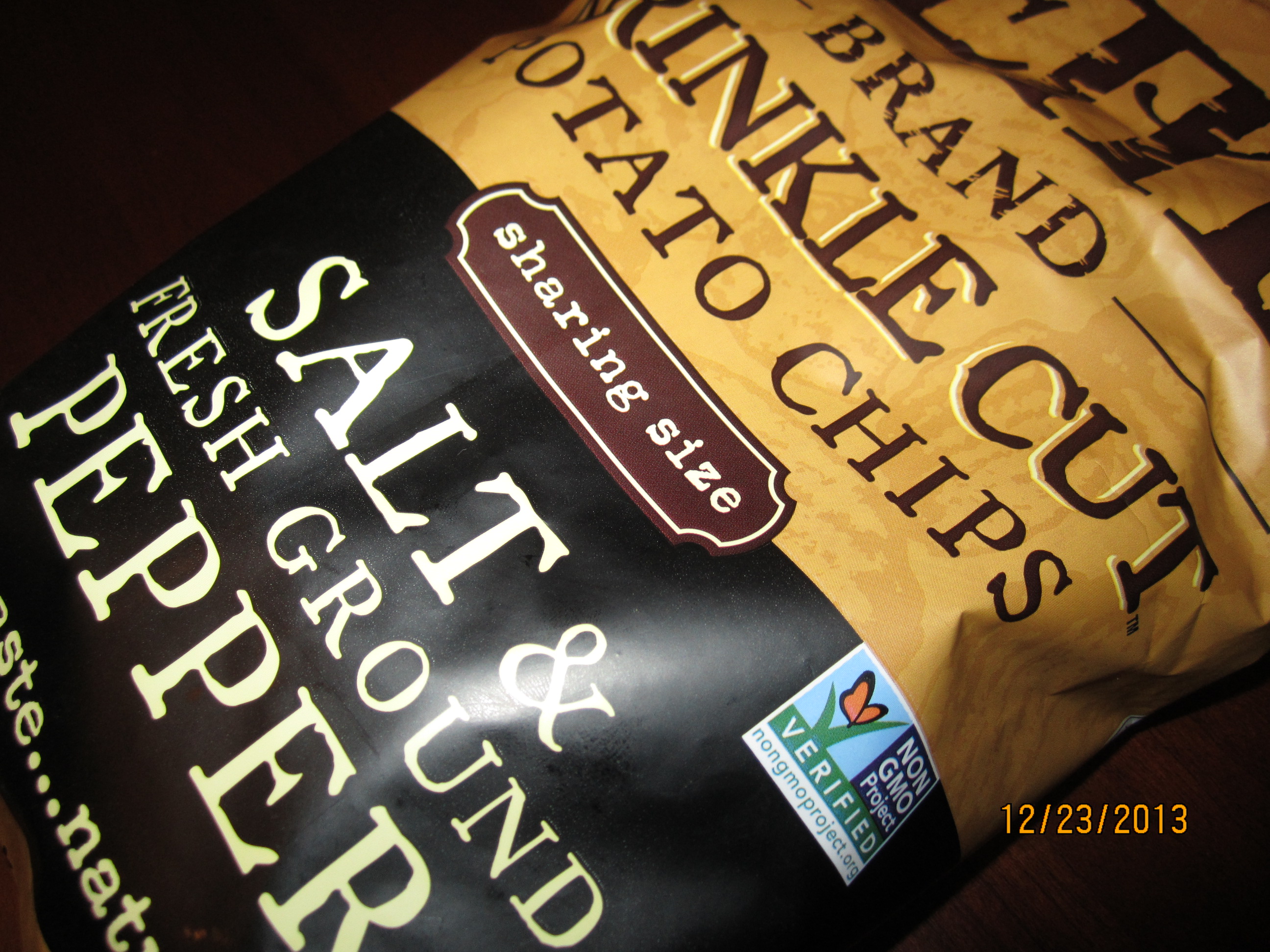
IMG_0005The label says “NON GMO Project VERIFIED” . So, what is n0n-GMO here? The potatoes? salt? pepper? Genetically modified potatoes are not a part of the food supply of any country on the planet. It is not possible for me to enjoy a genetically modified potato chip even if I was craving it, so why this label?  Perhaps in the hope that the consumer who hears a lot of fear mongering on this issue and, without actually checking on the particular details in the midst of a grocery run, will make a decision to buy this product instead of another.

From all the studies and research that I have followed so far, there appear to be no safety issues with GMO foods so there seems no reason to slap on what is tantamount to a warning label. But faced with the argument that no label indicates something is being hidden, I would advocate labeling because this is only one variable influencing the consumer’s decision to buy; and price is, I think, the variable that carries the greatest weight in that decision making process. But the real troubling issue here is how labeling can be subverted so that the concerns that are supposedly being met here (health, food safety etc) are simply a facade for the drive toward higher profits.

Are Nitrogen Fertilizers Used in Organic Farming?


fert

One of the benefits of organic farming is supposed to be the use of organic fertilizers, as opposed to the nitrogen based fertilizers used in conventional agriculture. This would imply that organic farming would not be contributing to the process of climate change. But this piece at Biofortified.org explains that the issue of how the manure (used as fertilizer in organic farming) was actually produced. If it came from conventionally raised animals then it is part of the same process as the nitrogen fertilizer used on conventional farms and very much a part of the climate change process. As always, these issues are not either/or ones and the need for nuance in discussions is essential. The whole issue is very well explained here.

GMOs: The View From Italy

italy

Absorbed as we tend to be in our own food system battles: food safety, labeling, etc; we tend to forget that similar struggles are taking place elsewhere. I always tend to think of Europe as solidly anti-GM although, there is a lively debate on right now in the UK, for example, on the adoption of GM technology. So, this piece on the import of GM corn by Italy was illuminating. First, the elaborate dance around growing/importing GM corn even when the current corn crop has been devastated by pests is entertaining to read. Also, I learnt that several countries in the EU do grow or import GM crops, somehow working through loopholes in the regulations banning this technology. And, finally, a familiar picture: no one is listening to what the farmers have to say. The final scene in the drama played out thus: Italian pigs will be fed GM corn imported from the US (but what will this mean for future prosciutto?!), while Italian farmers are left to deal with the consequences of a failed harvest. Too bad they cannot blame it all on Monsanto!

Golden Rice: Why We Need It

grice

When Golden Rice (rice enriched with Vitamin A) hit the news recently, it seemed like more of  the same: some are excited about its potential while others caution about its negative consequences. Lately, I have found myself too often reading and responding to the same arguments on this topic on Facebook and Twitter so I was intending to just watch from the sidelines the sidelines. What makes the debate on Golden Rice different, though, is that it was developed by scientists and the results of this research were handed over to the International Rice Research Institute (IRRI). There are no corporations involved so I wondered what  the  anti-GMO group would base their argument on this time; now that the all encompassing Monster Monsanto flag cannot be raised. Instead of  building up their case with evidence, however,  they decided to go the “shout louder” route and opted to destroy a field of trial golden rice being developed by IRRI in the Philippines.

Timely and accurate reporting ensured that we learnt that the farmers who were supposed to be protesting actually watched in dismay, while a crowd which was brought in for the purpose vandalized the field. This has provoked a strong reaction and protests from scientists the world over who came out in support of the freedom to conduct scientific research. This is, by no means, an isolated event. Incidents of vandalism of experimental work in GMOs is so rife that Switzerland recently found that about three quarters of the research budget for GMOs was actually being used for security. Those who demand the freedom to make their choices are, apparently, not too keen on freedom for others to make their own discoveries.

Then came this piece questioning the need for genetic modification of food and there were some points that really merit further discussion. First, the fortification of rice with Vitamin A  through genetic modification does work. There is a suggestion that eating more carrots or yams or distributing supplements might be just as effective in terms of health outcomes and less expensive than the money spent on GM research. Here, we need to open a little window into the world of those who would benefit most from this technology. The children suffering from Vitamin A deficiency often belong to the poorest sections of society, living in remote rural areas or urban slums. Distributing supplements to the would require the use of a public distribution system which can just as effectively used to distribute golden rice itself.

Next, why the focus on rice? In the lowest income groups, the largest portion of expenditure on food is on staples like cereal, even fruits and vegetables might be an occasional purchase. In India for example, the lower income group diet might consist of rice and lentils with chillies or onions as a side (hence the turmoil over the current rise in onion prices!). It makes sense to add the nutrient to the food group that is consumed at almost every meal and it is important to remind ourselves that in this world, far removed from our own comfortable one, there would be perhaps two meals a day (and certainly no snacks like those cute carrot sticks that are ubiquitous in schools and sand boxes here); so directing the nutrient in the most effective way is crucial. Carrots, yams or any other vegetable would be available only in season (unlike rice) and even then might not make the budget of many households; thus, they are not the best candidates for addressing the deficiency.

Of course, the best outcome would be for the diet to consist of golden rice and also carrots/yams. This brings us to another point of contention. Why frame this debate as an either/or question? There is a grave problem to be addressed here, let us bring the best combination of tools to the table to solve it. Let us celebrate Golden Rice as much as fortified pearl millet and let us do all we can to bring fresh produce to kitchens all over the world.

And then, of course, comes the question of safety. GMOs, we are cautioned, have not been proven safe for human consumption. So let us look at it one more time: the safety and benefits of genetic modification have been endorsed by many institutions so there is no credibility issue here. If one chooses to mistrust these institutions, then that is their personal choice and this should not be allowed to squander the chance to prevent blindness and death for millions of children. Again, we see the demand for freedom to choose for a certain section at odds with their acceptance of others’ right to the same.

No decision comes without a cost and opting for any course of action will involve a cost: do we allow children to to suffer now and try to find a different solution or alleviate suffering with the knowledge that we have today. (An excellent explanation of costs is here). Would we find a solution that satisfies the opponents of genetic modification? How long would this take if we started today? All this is uncertain. What is certain, however, is that we have a tool that can prevent blindness and death in children today and millions of children in need of it.